
Shipping Guide
Shipping Guide
I still remember one shipment early in my freight forwarding days where everything was perfect cargo ready, vessel booked, customer excited until we hit a wall at destination customs.
The issue wasn’t the cargo.
It wasn’t the shipping line.
It was a simple document: the Bill of Lading.
One incorrect consignee name on the B/L held a full container at the port for days. Demurrage kept building. The client was frustrated, and we had to fix it through a costly amendment.
That’s when it really hit me this document is not “just paperwork.” It controls the entire shipment flow.
Let’s break down the Bill of Lading Explained in a way that actually makes sense from real shipping operations, not textbook definitions.
A Bill of Lading (B/L) is a legal shipping document issued by a carrier (or freight forwarder) that serves three main purposes:
In simple terms:
It’s the official receipt + contract + ownership document for your shipment (depending on type).
Without it, international trade would be chaos. No one could prove ownership, claim cargo, or even clear customs properly.
In day-to-day freight forwarding, the Bill of Lading is not just a document—it is the center of control.
Here’s what I’ve personally seen it impact:
Customs officers rely heavily on B/L details:
Even a small mismatch can cause inspection delays.
Shipping lines will NOT release cargo without original B/L (or telex release, if applicable).
Banks often require a clean Bill of Lading before releasing payment in LC shipments.
In certain B/L types, ownership can change while goods are still in transit.
That’s powerful—and risky if not handled correctly.
In practice, you’ll deal with several types. Each one behaves differently in real shipments.
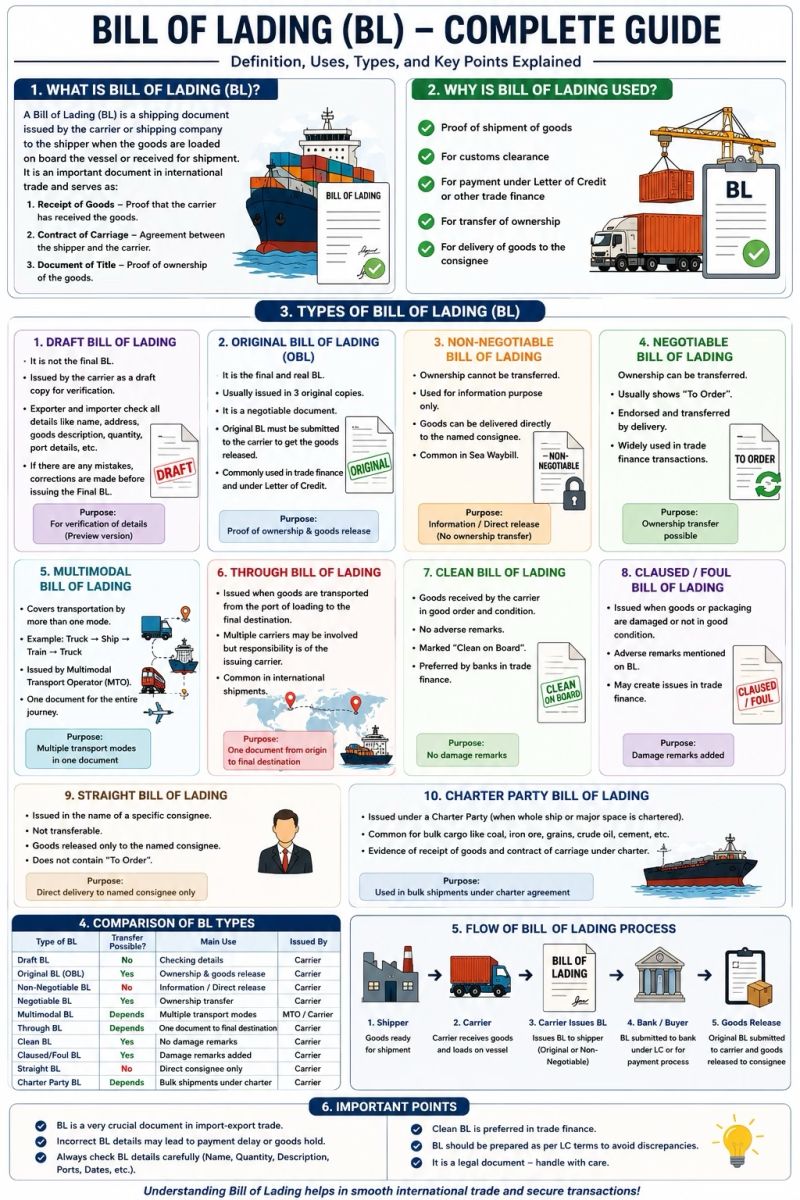
Non-negotiable
Cargo released only to named consignee
Common in pre-paid shipments
I usually see this in trusted buyer-seller relationships.
Negotiable
Ownership can be transferred
Requires endorsement
Used heavily in trade finance and LC shipments.
Not a document of title
No need for original copy to release cargo
Fast cargo release
Very common in repeat business shipments where trust is high.
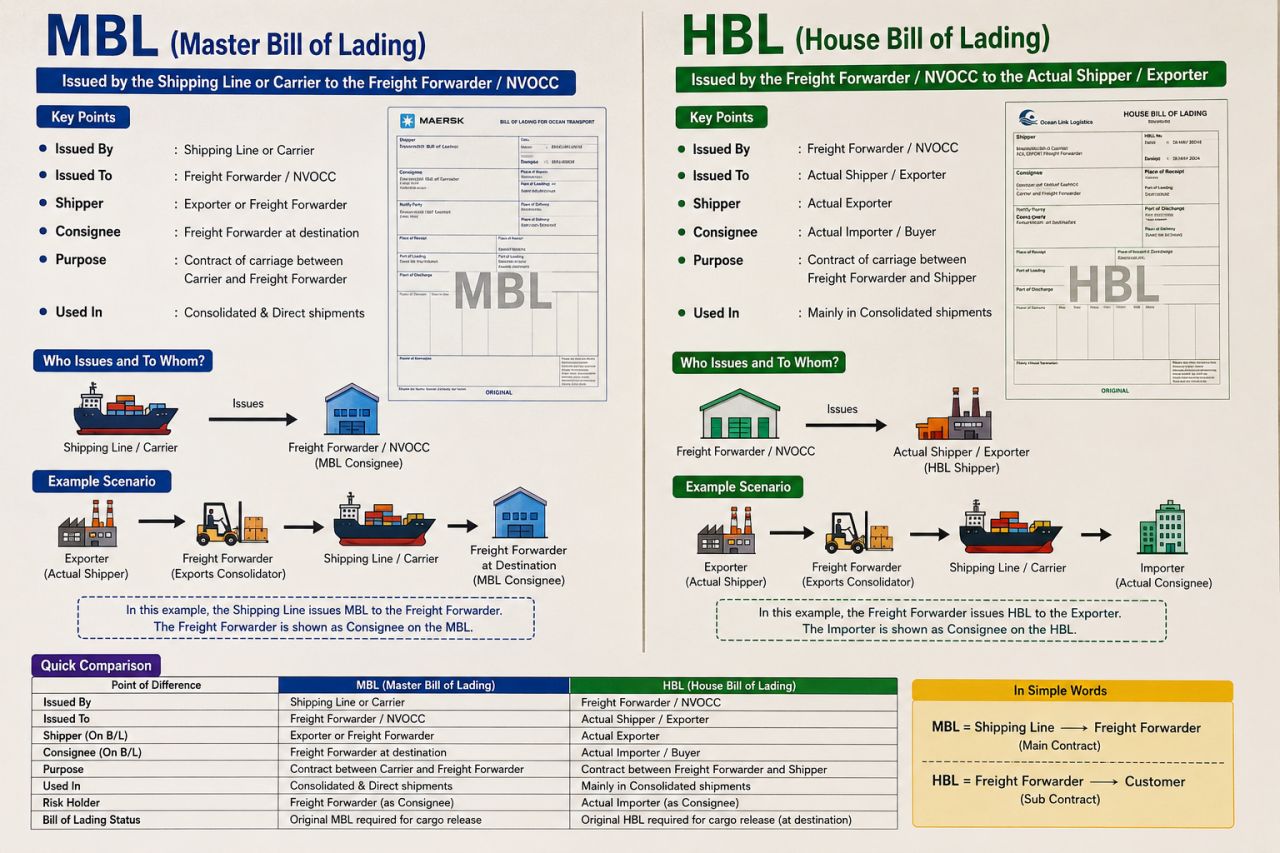
Issued by freight forwarder.
Used when cargo is consolidated
Shows forwarder as issuer
Works alongside Master B/L
Issued by shipping line.
Shows forwarder as consignee (in consolidation cases)
Used for carrier-level tracking
| Type | Negotiable | Used By | Cargo Release |
|---|---|---|---|
| Straight B/L | No | Named consignee only | |
| Order B/L | Yes | Traders, banks | Endorsed holder |
| Sea Waybill | No | Regular clients | Fast release |
| House B/L | No | Freight forwarders | Internal control |
| Master B/L | No | Shipping lines | Carrier level |
Let’s take a real shipment scenario from operations:
A Karachi exporter ships garments to Hamburg.
Step 1: Booking Confirmed
Freight forwarder books space with the shipping line.
Step 2: Cargo Stuffing
Container is loaded and sealed.
Step 3: Bill of Lading Issued
Two documents are created:
Master B/L by shipping line
House B/L by forwarder
Step 4: Payment Condition
Buyer requests original B/L under LC terms.
Step 5: Delay Happens
Exporter makes a mistake:
Consignee name slightly misspelled
Result:
This is not rare. It happens more often than people think.
Here’s the actual workflow in freight forwarding:
Carrier receives booking details:
Cargo is received at warehouse or port.
Forwarder or carrier generates draft B/L for approval.
This is where most mistakes happen:
Once confirmed, final B/L is issued.
Step 6: Cargo Release at Destination
Based on:
After years in freight forwarding, these are the most frequent issues:
Even a small typo can block cargo release.
This affects communication at destination.
Customs may flag shipment if description doesn’t match invoice.
Many beginners think all B/Ls work the same big mistake.
Delays in approval can miss vessel cut-off times.
These are things you only learn after handling real shipments:
Always Double-Check Before Final B/L
Never rush approval. One correction later costs money.
Use Sea Waybill for Trusted Buyers
If your client is repeat and reliable, avoid unnecessary delays.
Keep B/L Data Consistent Across Documents
Invoice, packing list, and B/L must match.
Understand Your Incoterms First
B/L handling changes depending on FOB, CIF, EXW, etc.
Communicate With Your Forwarder Clearly
Most B/L issues come from unclear instructions, not system errors
It’s a shipping document that acts as receipt, contract, and sometimes ownership proof for cargo.
The shipping line or freight forwarder depending on the shipment structure.
Yes, for ocean freight it is essential for cargo release and customs clearance.
HBL is issued by forwarder, MBL is issued by shipping line.
Yes, if it’s a sea waybill or telex release shipment.
You may face delays, amendment fees, customs issues, or cargo hold.
Only negotiable (order) B/Ls can be transferred through endorsement.
Usually 1–3 days after vessel departure, depending on carrier process.
This article is provided for educational purposes only. Shipping costs, freight rates, container capacity, and operational requirements may vary by carrier, country, cargo type, and shipment conditions.