
USA Import Guide
USA Import Guide
If you are importing goods into the United States, you may need a customs bond before your shipment can clear U.S. Customs and Border Protection (CBP).
A customs bond is a financial guarantee that ensures import duties, taxes, fees, and other customs obligations are paid and that the importer follows U.S. import regulations.
However, a customs bond is often misunderstood.
It is not insurance and does not protect your cargo from damage, theft, or loss during transportation. Instead, it protects the U.S. government by guaranteeing that the importer fulfills their customs responsibilities.
In simple terms:
If you import commercial goods that require a formal customs entry, you will usually need a customs bond.
The type of bond you need depends mainly on your importing frequency:
Understanding customs bond requirements before your shipment leaves the supplier can help prevent customs delays, storage charges, and clearance problems.
| Import Situation | Is a Customs Bond Required? | Common Option |
|---|---|---|
| Commercial import requiring formal customs entry | Usually Yes | Single Transaction or Continuous Bond |
| Regular business imports throughout the year | Usually Yes | Continuous Bond |
| One-time commercial shipment | Often Yes | Single Transaction Bond |
| Amazon FBA imports | Often Yes | Depends on import frequency |
| Personal shipments | Usually No | Not Applicable |
| Certain informal entries | May Not Be Required | Depends on CBP rules |
Important: Customs bond requirements are determined by the type of customs entry, imported goods, and applicable CBP regulations. Shipment value alone does not always determine whether a bond is required.
A customs bond is an agreement between three parties:
The bond acts as a guarantee that the importer will meet their obligations when bringing goods into the United States.
Those obligations may include:
Think of a customs bond as a financial promise:
If the importer fails to meet their customs obligations, the government has a financial guarantee to recover what is owed.
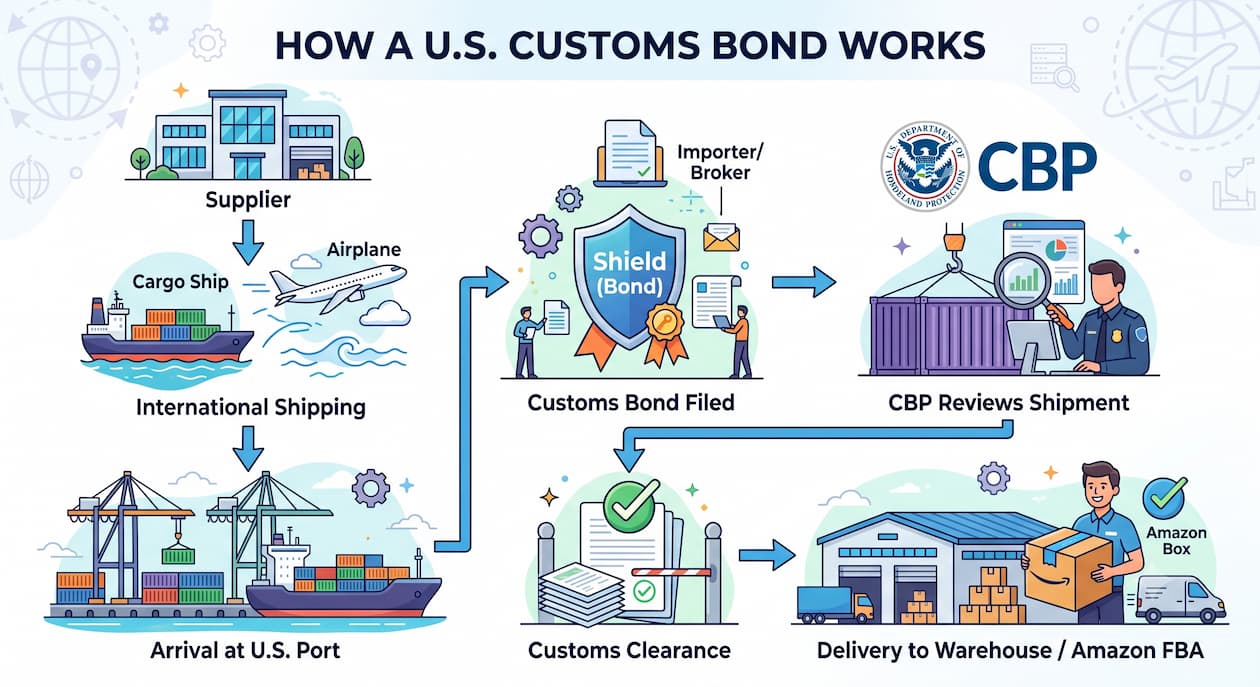
The process works like this:
Importer
↓
Obtains Customs Bond
↓
Surety Company Provides Guarantee
↓
CBP Accepts Bond
↓
Customs Entry Is Processed
↓
Shipment Can Be Released
If the importer follows all customs requirements, the bond remains unused.
If the importer fails to meet obligations, CBP can make a claim against the bond.
Many first-time importers confuse customs bonds with insurance.
They serve completely different purposes.
| Customs Bond | Cargo Insurance |
|---|---|
| Protects U.S. government interests | Protects importer’s cargo |
| Ensures customs obligations are fulfilled | Covers cargo loss or damage |
| Required in many commercial imports | Usually optional |
| Related to customs compliance | Related to transportation risks |
| Does not pay for damaged goods | May compensate for covered losses |
Example:
A shipment of electronics arrives damaged after ocean transportation.
A company may need both cargo insurance and a customs bond because they solve different risks.
U.S. Customs and Border Protection handles millions of import transactions every year.
A customs bond helps CBP ensure that importers remain financially responsible and follow U.S. trade regulations.
The main reasons CBP requires customs bonds are:
When goods enter the United States, importers may owe:
A customs bond provides financial protection if an importer fails to pay amounts owed.
Example:
A company imports commercial machinery but does not pay required duties after customs assessment.
CBP can use the bond process to recover the unpaid amount.
Importers are responsible for providing accurate information about their goods.
This includes:
A customs bond encourages importers to maintain proper compliance because failure to meet requirements can create financial consequences.
Without a bond system, CBP would have limited protection when releasing goods before every possible obligation is fully resolved.
The bond allows legitimate businesses to move goods through customs while maintaining accountability.
A customs bond is mainly required for businesses importing goods commercially into the United States.
Common users include:
Businesses importing products for resale, manufacturing, or distribution often require customs bonds.
Examples:
Amazon sellers importing inventory directly into the United States may require a customs bond if their shipment requires a formal customs entry.
A common misunderstanding is:
Amazon receives my products, so Amazon handles customs.
This is incorrect.
Usually:
Amazon only receives inventory after the shipment has cleared customs.
Companies importing multiple shipments throughout the year commonly use continuous customs bonds.
Examples:
A continuous bond simplifies the process because the importer does not need to arrange a new bond for every shipment.
Businesses importing a single shipment may still need a customs bond.
Example:
A company purchases one container of furniture from Vietnam to test the U.S. market.
A Single Transaction Bond may be appropriate because there is no ongoing import activity.
A common misunderstanding is that the freight forwarder or customs broker "provides" the customs bond.
The reality is slightly different.
Customs Broker
A customs broker can:
However, the importer remains responsible for compliance.
Freight Forwarder
A freight forwarder can:
However, the freight forwarder is generally not the importer responsible for the customs bond.
A customs bond is commonly required when a shipment enters the United States through a formal customs entry process.
Common situations include:
Example:
A company imports 500 cartons of clothing from Bangladesh for resale in the United States.
Because this is a commercial import, customs bond requirements may apply.
Example:
An Amazon seller imports products from China directly into an Amazon fulfillment center.
If the shipment requires formal entry, a customs bond is generally needed before CBP clearance.
Companies importing frequently usually maintain a continuous bond to simplify recurring shipments.
Certain products may require additional compliance with government agencies.
Examples include:
Depending on the shipment, additional requirements may apply.
Not every shipment entering the United States requires a customs bond.
Possible situations where a bond may not be required include:
However, businesses should not assume that a bond is unnecessary simply because a shipment is small or inexpensive.
The requirement depends on:
Before your cargo leaves the supplier, confirm:
Resolving these questions before departure is much easier than fixing customs issues after cargo arrives at a U.S. port.
Once you determine that your shipment requires a customs bond, the next question is:
Which type of customs bond do I need?
For most importers, the choice comes down to two common options:
The right choice depends mainly on how frequently you import and whether importing is a one-time activity or an ongoing part of your business.
A Single Transaction Bond covers one specific customs entry.
After that shipment completes the customs clearance process, the bond is no longer used for future imports.
This option is commonly chosen by:
Example: Single Transaction Bond
A U.S. company imports one container of kitchen products from China to test market demand.
They do not expect another shipment for several months.
In this case, obtaining a Single Transaction Bond may make more sense than maintaining an annual bond.
In this case, obtaining a Single Transaction Bond may make more sense than maintaining an annual bond.
Advantages of Single Transaction Bond
| Advantage | Explanation |
|---|---|
| Suitable for occasional imports | No need for a yearly bond commitment |
| Simple setup | Arranged only when needed |
| Good for first-time importers | Useful when import volume is uncertain |
Limitations of Single Transaction Bond
| Limitation | Explanation |
|---|---|
| New bond required for future shipments | Each qualifying import needs separate arrangements |
| More administrative work | Frequent importers repeat the process |
| May become inefficient | Multiple shipments can make this approach less practical |
A Continuous Customs Bond covers multiple customs entries during its validity period.
It is generally used by companies that import regularly throughout the year.
Common users include:
Example: Continuous Bond
An Amazon seller imports inventory from China every month.
Instead of arranging a separate bond for every shipment, the importer obtains a Continuous Bond that supports ongoing imports.
This reduces administrative work and makes future customs clearance easier.
Single Transaction Bond vs Continuous Bond Comparison
| Feature | Single Transaction Bond | Continuous Bond |
|---|---|---|
| Best For | Occasional imports | Regular importers |
| Coverage | One customs entry | Multiple entries |
| Validity | One shipment | Usually one year |
| Ideal User | First-time or infrequent importer | Established importing businesses |
| Administration | More frequent arrangements | Simplified recurring process |
| Long-term suitability | Limited | Better for growing import operations |
A simple decision approach:
Choose Single Transaction Bond if:
Consider Continuous Bond if:
Expert Recommendation
Many businesses start with Single Transaction Bonds because they are new to importing.
However, as import volume grows, it is worth reviewing whether a Continuous Bond provides better efficiency.
The decision should not only consider today's shipment but also your expected importing activity over the next year.
How Much Does a Customs Bond Cost?
One of the most common questions from new importers is:
How much does a customs bond cost?
The answer depends on several factors.
There is no universal price because customs bond costs vary based on:
The cost structure differs between:
A bond covering one shipment is evaluated differently from a bond supporting multiple imports throughout the year.
The required bond amount is influenced by factors such as:
Higher-risk or higher-value imports may require higher bond amounts.
A business importing once has a different requirement compared with a company importing weekly.
For example:
| Importer Type | Likely Consideration |
|---|---|
| One-time importer | Single Transaction Bond |
| Monthly importer | Continuous Bond may be more practical |
| High-volume importer | Long-term customs compliance planning |
Certain products may involve additional compliance considerations.
Examples:
Additional requirements may affect the overall import process.
Customs bonds are issued through approved surety companies.
Pricing and approval requirements can vary depending on:
Avoid choosing a customs bond provider only based on the lowest advertised price.
A cheaper option that causes delays, incorrect filings, or poor communication can create much higher costs through:
The goal is not only obtaining a bond.
The goal is ensuring smooth customs clearance
Obtaining a customs bond is usually straightforward when planned before shipment departure.
Most importers arrange their bond through:
Before shipping:
Confirm:
Your customs broker can help determine the requirement.
Choose between:
Single Transaction Bond
For
Continuous Bond
For
The bond provider or customs broker may require information such
Once approved:
Your customs broker files the import entry with CBP.
The process typically involves:
CBP reviews the entry.
If all requirements are satisfied:
Many new importers think about customs bonds only after cargo arrives.
That is too late.
A customs bond should be planned during the shipment preparation stage.
A simplified import flow:
Supplier Order
↓
Manufacturing
↓
International Freight
↓
Arrival in USA
↓
Customs Entry Filing
↓
Customs Bond Verification
↓
CBP Clearance
↓
Cargo Release
↓
Final Delivery
Understanding the difference between Importer of Record and Customs Bond is essential.
They are connected but serve different purposes.
The Importer of Record (IOR) is the party legally responsible for the imported goods.
The IOR is responsible for:
The customs bond supports the Importer of Record's obligations.
Simple explanation:
Importer of Record = Responsible party
Customs Bond = Financial guarantee
| Legal Responsibility | Financial Guarantee |
|---|---|
| Owns import compliance responsibility | Supports customs obligations |
| Declares goods | Guarantees payment/compliance |
| Can be a company or individual | Issued through a surety |
Another common misunderstanding:
Does my customs broker become responsible because they filed my entry?
No.
A customs broker helps with the process, but the importer remains responsible for the accuracy of the information provided.
A customs broker can:
However
Amazon FBA sellers often face confusion because multiple parties are involved:
Understanding responsibilities is critical.
Supplier
↓
International Freight Forwarder
↓
Customs Broker
↓
CBP Customs Clearance
↓
Amazon Fulfillment Center
Amazon does not automatically provide a customs bond for sellers.
The importer must ensure:
Assuming Amazon Handles Import Compliance
Amazon receives inventory after clearance.
It does not replace the seller's import responsibilities.
Shipping Before Confirming Customs Requirements
Some sellers arrange international shipping first and only later discover customs documentation issues.
Better approach:
Confirm:
before cargo departure.
Using the Wrong Bond Type
A seller importing monthly inventory may spend unnecessary time arranging individual bonds when a Continuous Bond may be more practical.
Based on real freight forwarding operations, the biggest customs bond problems usually happen because businesses treat customs clearance as an afterthought.
A better approach:
Discuss customs requirements before:
Using a freight forwarder or customs broker does not remove your responsibility.
You should understand:
If you are moving from occasional imports to regular shipments, review whether your customs bond strategy still makes sense.
Incorrect information can create:
Even experienced businesses can face customs delays when customs bond requirements are misunderstood.
Most problems do not happen because the bond process is complicated. They happen because importers treat customs compliance as something to solve after the shipment arrives.
Below are the most common mistakes and how to avoid them.
Many new importers assume:
My freight forwarder is handling shipping, so they will handle the customs bond.
This is a common misunderstanding.
A freight forwarder manages transportation and logistics coordination, but the importer remains responsible for customs compliance.
A freight forwarder may help connect you with:
However, the importer must ensure the correct customs arrangements are in place.
Before shipping, confirm:
This is one of the most common misunderstandings among first-time importers.
A customs bond does not protect your shipment.
It does not cover:
Those risks are handled through cargo insurance.
Those risks are handled through cargo insurance.
Simple Example
A container of clothing arrives damaged after ocean transportation.
Some importers only discover they need a customs bond after their shipment reaches a U.S. port.
This creates unnecessary problems.
Possible consequences
Better Approach
Confirm customs requirements before:
Experienced importers treat customs planning as part of shipment preparation, not as an emergency step after arrival.
Experienced importers treat customs planning as part of shipment preparation, not as an emergency step after arrival.
A common mistake is selecting a bond based only on the current shipment without considering future importing plans.
Example:
A business imports one shipment and purchases a Single Transaction Bond.
Six months later, the same company begins importing every month.
At that point, they may realize a Continuous Bond would have simplified their operations.
Better Approach
Consider:
Some businesses assume their customs broker or freight forwarder becomes responsible for everything.
That is incorrect.
The Importer of Record remains responsible for:
A customs broker assists with the process but does not remove the importer's responsibility.
Customs clearance depends heavily on accurate shipment information.
Incorrect details can affect:
Common issues include:
Example
Instead of declaring:
Plastic kitchen storage containers
an importer should provide accurate product details including material, purpose, and specifications.
Better information leads to smoother customs processing.
Some importers choose a customs bond provider only because of the lowest price.
However, customs clearance is not only about the bond fee.
Poor coordination can create much larger costs through:
The cheapest option is not always the most cost-effective option.
Based on practical freight forwarding experience, successful importers usually follow a few simple principles.
Do not wait until cargo reaches the United States.
Before shipment departure, confirm:
A reliable customs broker can help you:
Choose partners who understand your product category and import volume.
Your customs requirements may change as your business grows
For example:
A business importing once per year may only need occasional bond arrangements.
The same business importing every month may benefit from a Continuous Bond.
Review your approach as your import volume increases.
Keep organized records of:
Good documentation helps with future shipments and customs compliance reviews.
A customs bond is an important part of the U.S. import process for many commercial shipments.
Remember:
The biggest mistake importers make is treating customs compliance as an afterthought.
A well-planned customs process, including the correct customs bond, helps prevent delays and creates a smoother import experience.
No. Not every shipment requires a customs bond. However, many commercial imports requiring formal customs entry generally need one.
The requirement depends on:
A customs bond guarantees that an importer fulfills obligations to U.S. Customs and Border Protection.
It helps ensure payment of:
It also supports compliance with U.S. import regulations.
A freight forwarder may help arrange a customs bond through a customs broker or surety provider.
However, the importer remains responsible for ensuring that the required bond is obtained.
Yes.
Many customs brokers help importers obtain customs bonds through approved surety companies.
They can also advise which type of bond may be suitable.
A continuous customs bond generally covers import entries for one year and must typically be renewed if the importer wants continued coverage.
Importers should confirm current requirements with their customs broker or bond provider.
Yes.
Amazon FBA sellers who import regularly may use a Continuous Bond to support multiple qualifying shipments.
However, the correct choice depends on their import activity and customs entry requirements.
Foreign companies importing goods into the United States may need a customs bond depending on their import arrangements and whether they act as the Importer of Record.
They should confirm requirements before shipping.
If a required bond is missing, customs clearance may be delayed.
Possible consequences include:
Should I get a Single Transaction Bond or Continuous Bond?
Choose a Single Transaction Bond if:
Consider a Continuous Bond if:
This article is provided for educational purposes only. Shipping costs, freight rates, container capacity, and operational requirements may vary by carrier, country, cargo type, and shipment conditions.