Published by Freight Learner | Reviewed by Murtaza M. |
Last Updated: July 2026
Introduction
Amazon FBA inbound shipping requirements define how sellers must prepare, label, document, and deliver inventory before Amazon accepts products into its fulfillment network.
Every shipment entering an Amazon warehouse must meet specific preparation standards. This includes correct product labeling, carton labels, packaging requirements, shipment information, and import documentation.
Incorrect preparation can result in:
receiving delays
shipment discrepancies
additional handling fees
inventory being refused or returned
delays in making products available for sale
For international sellers importing inventory into the USA, FBA preparation is not only an Amazon requirement but also a logistics process involving suppliers, freight forwarders, customs brokers, and carriers.
Before shipping inventory to Amazon, sellers should confirm that products are correctly labeled, cartons are prepared according to Amazon requirements, documents are complete, and the transportation plan matches Amazon delivery requirements.
Quick Checklist: Amazon FBA Shipment Requirements
Before shipping inventory to Amazon FBA, confirm the following:
Product Preparation
Products have correct FNSKU labels (if required)
Product packaging meets Amazon requirements
Barcode information matches Amazon shipment details
Products are properly packed and protected
Restricted product requirements have been reviewed
Carton Preparation
Carton dimensions are within Amazon requirements
Cartons are strong enough for transportation
Carton weight limits are checked
FBA carton labels are printed correctly
Shipping labels are attached clearly
Old labels or barcodes are removed or covered
Documentation
Commercial invoice prepared
Packing list prepared
Customs requirements reviewed
Export documents completed
Customs requirements reviewed
Importer of Record details confirmed
Freight Preparation
Shipping method selected (air, LCL, FCL)
Freight booking completed
Tracking information available
Customs clearance arranged
Delivery appointment requirements confirmed
Amazon FBA Inbound Shipping Process Step-by-Step
Shipping products to Amazon FBA involves multiple stages. A mistake at any stage can create delays later in the supply chain.
Step 1: Supplier Preparation
The process starts at the supplier or manufacturing facility.
Before production begins, sellers should confirm:
Product specifications
Packaging requirements
Label placement
Carton dimensions
Quantity per carton
Shipping marks
Many FBA problems happen because suppliers prepare goods according to normal export practices rather than Amazon requirements.
A supplier may successfully export products worldwide but still prepare cartons incorrectly for Amazon receiving.
Before production is completed, provide your supplier with:
FNSKU labels
Product preparation instructions
Carton labeling requirements
Packing instructions
Step 2: Product Labeling
Amazon requires products to be identifiable when received at fulfillment centers.
Most private-label sellers use an FNSKU barcode.
What is an FNSKU Label?
FNSKU stands for Fulfillment Network Stock Keeping Unit.
It is Amazon's unique barcode used to identify a seller's specific product inventory.
For example:
Two sellers may sell the same product from the same manufacturer.
Amazon uses FNSKU labels to identify which seller owns the inventory.
Product labels should:
Be printed clearly
Match the correct Amazon listing
Cover existing manufacturer barcodes when required
Remain scannable throughout handling
Step 3: Carton Preparation
After products are labeled, cartons must be prepared for transportation and Amazon receiving.
The supplier or warehouse should confirm:
Number of units per carton
Carton dimensions
Gross weight
Net weight
Carton markings
This information is required for:
freight calculations
customs documentation
shipment creation
warehouse receiving
Incorrect carton information can affect freight cost calculations and create receiving issues.
For example:
A supplier provides incorrect carton dimensions:
Actual carton:
60 × 40 × 40 cm
Declared carton:
50 × 35 × 35 cm
This can result in incorrect CBM calculations, freight cost adjustments, and shipment discrepancies.
Step 4: Create Amazon Shipment Plan
Before booking transportation, sellers create an inbound shipment plan inside Amazon Seller Central.
This identifies:
products being shipped
quantities
fulfillment center destination
shipment details
carton information
Amazon may assign inventory to different fulfillment centers depending on the shipment settings.
The information created here should match the physical shipment.
Common mistakes include:
shipping different quantities than declared
sending cartons with incorrect dimensions
changing products after creating the shipment
using incorrect labels
Step 5: Book Freight
After shipment details are confirmed, transportation can be arranged.
The shipping method depends on:
inventory size
urgency
product value
available budget
expected selling demand
Common options include:
Air Freight
Used For
smaller shipments
urgent restocking
new product launches
Advantages:
faster transit
lower inventory waiting time
Disadvantages:
higher cost per kg
Sea Freight
Used for
larger inventory shipments
regular replenishment
cost-sensitive products
Advantages
lower transportation cost
suitable for bulk shipments
Disadvantages
longer transit times
more planning required
Step 6: Export Documentation
International shipments require correct export documents.
Typical documents include:
Commercial invoice
Packing list
Bill of lading or airway bill
Export declaration (depending on origin country)
Incorrect documentation can delay export clearance or create customs issues.
Step 7: Customs Clearance
For shipments entering the USA, customs clearance must be completed before delivery to Amazon.
The process may involve:
Importer of Record confirmation
Customs broker coordination
Duty calculation
Customs entry filing
Regulatory checks
Amazon does not act as the importer of record for most seller shipments.
The seller or appointed logistics partner must arrange import compliance.
Step 8: Delivery to Amazon Fulfillment Center
The final stage is delivery into Amazon's warehouse network.
Depending on shipment type, requirements may include:
carrier appointment
delivery scheduling
pallet requirements
warehouse receiving instructions
The freight forwarder or carrier should confirm delivery requirements before dispatching the shipment.
A shipment arriving at the wrong location or without correct preparation can face unnecessary delays.
Amazon FBA Carton Labeling Requirements
Correct carton labeling is one of the most important parts of preparing an Amazon FBA shipment.
Amazon fulfillment centers receive thousands of shipments daily. Labels allow warehouse teams and automated systems to identify:
who owns the inventory
what products are inside
where the shipment belongs
how the inventory should be processed
A missing or incorrect label can slow down receiving or create additional processing requirements.
What Are Amazon FBA Carton Labels?
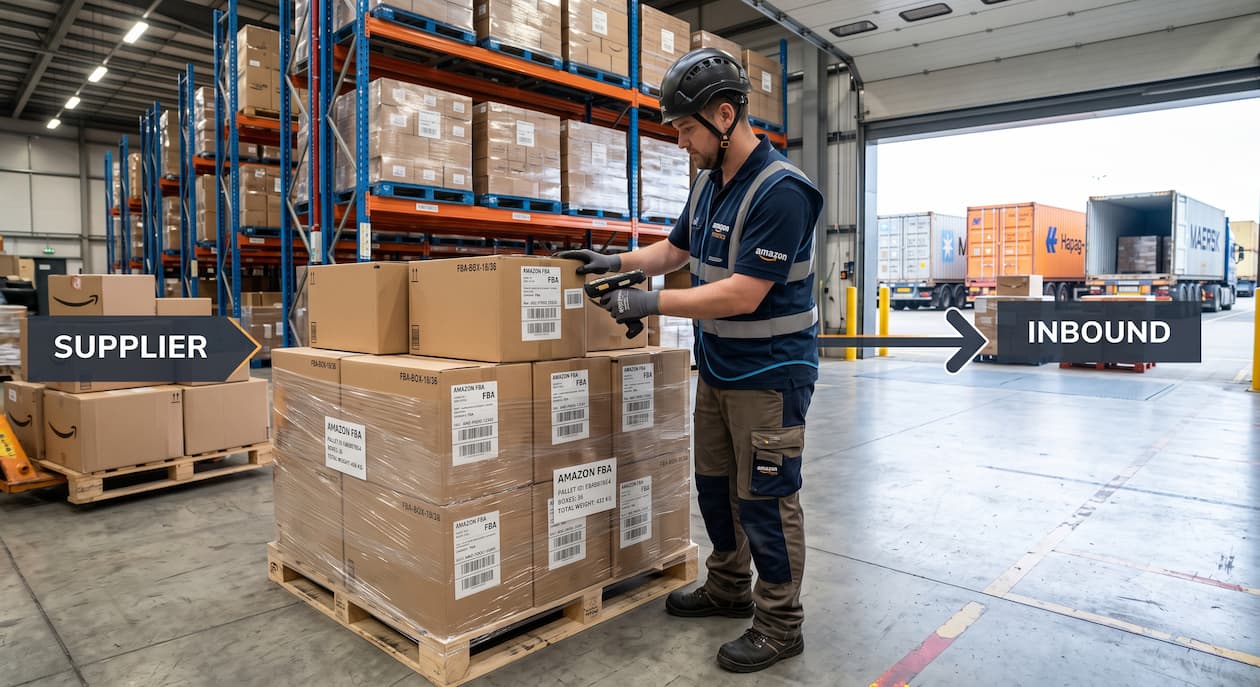
Amazon FBA carton labels are identification labels attached to each shipping carton sent to an Amazon fulfillment center.
A carton label provides information about:
shipment identification
carton number
warehouse destination
barcode information
Every carton in the shipment must have the correct label attached before delivery.
Example:
A shipment contains:
20 cartons
100 units per carton
Each of the 20 cartons requires its own carton label.
Do not place one label only on the pallet and assume Amazon can identify individual cartons.
Types of Labels Required For Amazon FBA Shipments
There are usually two main categories of labels sellers need to understand:
1.Product labels
2.Carton/shipping labels
1.FNSKU Product Labels
What Is an FNSKU Label?
An FNSKU (Fulfillment Network Stock Keeping Unit) is Amazon's unique product barcode assigned to a seller's inventory.
It identifies:
the seller
the specific product
the fulfillment inventory ownership
For private-label sellers, FNSKU labels are commonly applied over the manufacturer's barcode.
Example:
A factory produces 5,000 phone cases.
Several sellers may sell similar phone cases.
Amazon uses the FNSKU barcode to identify which seller's inventory is being received.
FNSKU Label Requirements
The label should:
Match the correct Amazon product listing
Be printed clearly
Be scannable
Be securely attached
Cover other scannable barcodes when required
Avoid
placing labels over curved surfaces
using low-quality printing
applying labels where they can easily peel off
placing multiple competing barcodes on the same product
2. Amazon FBA Carton Labels
Carton labels identify the outer shipping box.
Each carton sent to Amazon must have the correct shipment label.
The label normally includes:
barcode
shipment information
destination information
carton identification
The label is generated from Amazon Seller Central after creating the shipment.
Where Should Amazon FBA Carton Labels Be Placed?
Carton labels should be:
Placed on a flat surface
Easily visible
Not covered by tape or packaging material
Away from carton edges
Not placed over seams where the label may become damaged
Best practice:
Place the label on the largest side of the carton where warehouse staff can scan it easily.
Practical Carton Label Example
A shipment contains:
Product: Wireless headphones
Shipment: 500 units
Packing: 50 units per carton 10 cartons total
Each carton should have:
Amazon shipment carton label
Correct carton information
Product identification details where required
The warehouse should not need to open cartons to identify the shipment.
Barcode Requirements
Amazon uses barcode scanning throughout the receiving process.
Labels should:
have high-quality printing
have sufficient contrast
avoid wrinkles
avoid damage
remain readable during transportation
Common barcode problems:
❌ Blurry printing
❌ Labels damaged by moisture
❌ Barcode covered with tape glare
❌ Multiple conflicting barcodes visible
Amazon FBA Packaging Requirements
Packaging protects products during:
international transportation
customs inspection
warehouse handling
customer fulfillment
Poor packaging can cause:
damaged inventory
customer complaints
additional preparation fees
Carton Strength Requirements
Shipping cartons should be strong enough to survive international transportation.
Consider:
For international freight, standard export cartons are commonly preferred.
Weak cartons may collapse during:
container loading
unloading
warehouse storage
Carton Weight Requirements
Amazon has specific requirements regarding carton weight.
standard cartons should not exceed Amazon's allowed weight limits
overweight cartons may require special handling
extremely heavy cartons can create safety issues
Always confirm current limits in Amazon Seller Central because requirements can change based on fulfillment center policies and product category.
Carton Dimension Requirements
Accurate carton dimensions are important because they affect:
• Amazon shipment information
• freight cost calculations
• CBM calculations
Before shipping, confirm:
length
width
height
gross weigh
number of units per carton
Incorrect dimensions can create:
freight invoice adjustments
shipment discrepancies
receiving delays
Pallet Requirements For Amazon FBA
Some FBA shipments require palletization, especially:
larger shipments
LTL deliveries
freight delivered by trucking companies
Common pallet considerations:
pallets should be strong and suitable for transport
cartons should be secured properly
labels should remain visible
pallet information should match shipment details
For USA imports, many sellers use:
standard wooden pallets
heat-treated pallets compliant with ISPM 15 requirements for international shipping
Poly Bag Requirements
Certain products require poly bag protection.
Examples
Clothing
textiles
small items
products with loose components
Poly bags may require:
Suffocation warning lables
secure sealing
correct sizing
Fragile Product Requirements
Fragile products require additional preparation.
Examples
glass products
electronics
decorative items
Recommended precautions:
Bubble wrapping
Protective inserts
Strong cartons
"Fragile" handling instructions where appropriate
Restricted Product Considerations
Some products require additional compliance before shipping to Amazon.
Examples
batteries
cosmetics
food products
medical-related products
chemicals
Before importing, verify:
Amazon category requirements
customs requirements
government regulations
Required Documents For Amazon FBA Imports
International FBA shipments require proper documentation.
Missing documents can delay customs clearance and warehouse delivery.
Commercial Invoice
The commercial invoice is one of the most important import documents.
It provides:
seller/exporter details
buyer/importer details
product description
quantity
unit value
total value
HS code
country of origin
Incoterms
Customs authorities use this document to determine:
admissibility
duty calculation
compliance requirements
Packing List
The packing list explains how goods are physically packed.
It includes:
carton count
carton dimensions
product quantities
weights
packing details
Example:Shipment:20 cartons Each carton:
50 Units
12kg gross weight
60x40x40 cm
This information helps freight forwarders, customs brokers, and warehouses verify the shipment.
Bill of Lading (Sea Freight)
For ocean shipments, the bill of lading acts as:
shipment receipt
transportation contract
cargo document
Types include:
Original Bill of Lading
Sea Waybill
Air Waybill (Air Freight)
Air shipments use an Air Waybill (AWB).
It provides:
airline shipment details
tracking information
consignee information
Certificate of Origin
A certificate of origin confirms where products were manufactured.
It may be required for:
customs purposes
trade agreements
specific product categories
Customs Documents
Depending on the product and origin country, additional documents may include:
customs declarations
permits
compliance certificates
product certifications
Shipping Methods To Amazon FBA USA
Choosing the correct shipping method affects:
cost
delivery speed
inventory availablity
cash flow
The main options are:
Air Freight
Sea Freight
Air Freight For Amazon FBA
>
Air freight is commonly used for:
new product launches
urgent inventory replenishment
high-value products
small shipments
Advantages
Faster transit
Lower inventory waiting time
Useful for testing products
Disadvantages
Higher transportation cost
Less suitable for large volumes
Sea Freight For Amazon FBA
Sea freight is usually preferred for:
bulk inventory
regular shipments
larger products
Advantages
Lower cost per unit
Suitable for high-volume shipments
Better for long-term inventory planning
Disadvantages
Longer transit time
Requires better planning
LCL Shipping To Amazon FBA
LCL (Less than Container Load) means sharing container space with other shipments.
Best for:
smaller shipments
sellers who do not need a full container
Considerations:
additional handling
consolidation time
possible extra warehouse charges
FCL Shipping To Amazon FBA
FCL (Full Container Load) means one shipment occupies the entire container.
Common container sizes:
20-fot container
40-foot container
40-foor high cube container
Best for:
large inventory volumes
established sellers
cost-efficient bulk shipping
Transit Time Considerations
Shipping time depends on:
origin country
destination port
customs clearance
freight method
carrier schedule
A seller should consider:
Production time + transportation time + customs clearance + Amazon receiving time when planning inventory.
Freight Forwarder Role In Amazon FBA Shipments
A freight forwarder helps coordinate the movement of goods from supplier to Amazon fulfillment center.
For international sellers, they often manage multiple parts of the supply chain.
Supplier Pickup
The freight forwarder can arrange:
factory pickup
warehouse collection
export transportation
Export Documentation
They help coordinate:
shipping documents
export requirements
carrier bookings
International Transportation
They manage:
Oceans freight
air freight
carrier communication
shipment tracking
Customs Clearance
A freight forwarder can coordinate with customs brokers for:
import documentation
customs entry
duty processing
Amazon Delivery Coordination
The final delivery stage requires attention.
A logistics partner can assist with:
appointment requirements
trucking arrangements
warehouse delivery coordination
A good Amazon FBA freight partner does not only move cargo. They help prevent mistakes before the shipment reaches Amazon.
Common Amazon FBA Shipping Mistakes
Many Amazon FBA shipment problems are not caused by transportation itself. They usually happen because preparation, documentation, or shipment information does not match Amazon requirements.
Below are common mistakes sellers should avoid.
1. Incorrect FNSKU Labels
One of the most common FBA receiving issues is incorrect product labeling.
Common problems:
❌ Using the manufacturer barcode instead of FNSKU when required
❌ Applying the wrong FNSKU to products
❌ Barcode cannot be scanned
❌ Label placed over an uneven surface
❌ Multiple visible barcodes creating confusion
How to avoid it:
Before shipment:
Download correct labels from Amazon Seller Central
Verify SKU and product match
Ask supplier to send label placement photos
Test barcode scanning before mass production
2. Missing Carton Labels
Every carton shipped to Amazon must have the correct carton label.
Common mistakes:
Only labeling one carton in a shipment
Printing unclear labels
Placing labels where they are damaged during transport
Using old shipment labels from previous deliveries
Prevention:
Before pickup:
Count cartons
Confirm every carton has a label
Match carton quantity with Amazon shipment details
3. Incorrect Carton Information
Carton details directly affect:
freight calculation
customs documents
shipment creation
warehouse receiving
Common errors:
Wrong carton dimensions
Incorrect carton weight
Incorrect quantity per carton
Example:
Supplier confirms:50 cartons × 20 units
Actual shipment:50 cartons × 24 units
This creates a mismatch between physical inventory and Amazon shipment records.
4. Ignoring Customs Requirements
Some sellers focus only on Amazon requirements and forget import compliance.
Problems may include:
incorrect HS codes
missing import documents
incorrect product descriptions
missing certifications
A shipment can be prepared perfectly for Amazon but still be delayed at customs.
5. Choosing Freight Based Only on Cheapest Price
The lowest freight quote is not always the cheapest option.
A cheaper quote may exclude:
customs clearance
destination charges
warehouse fees
delivery appointment costs
documentation handling
Always compare the complete landed cost.
6. Not Planning Inventory Lead Time
>
Many sellers calculate only transportation time.
Actual timeline:Production time
Export preparation
Freight transit
Customs clearance
Final delivery
Amazon receiving time
A shipment arriving at the port does not mean inventory is immediately available for sale.
7. Incorrect Shipment Information in Amazon Seller Central
The shipment details inside Amazon should match the physical cargo.
Common mistakes:
wrong number of cartons
incorrect product quantity
wrong shipment destination
changing products after shipment creation
Always verify shipment information before cargo departure.
Amazon FBA Shipment Preparation Checklist
Use this checklist before sending inventory to Amazon fulfillment centers.
Before Shipment Leaves Supplier
☐ Product quantity confirmed
☐ Product quality inspection completed
☐ FNSKU labels applied correctly
☐ Product packaging checked
☐ Carton dimensions measured
☐ Carton weights verified
☐ Carton labels printed and attached
☐ Export documents prepared
☐ Commercial invoice reviewed
☐ Packing list reviewed
☐ Freight booking confirmed
Before International Shipping
☐ Shipping method selected (Air/LCL/FCL)
☐ Freight forwarder instructions confirmed
☐ HS codes verified
☐ Import requirements checked
☐ Customs broker arranged
☐ Insurance requirements reviewed
☐ Tracking information available
Before Delivery To Amazon Warehouse
☐ Shipment details match physical cartons
☐ Delivery appointment requirements confirmed
☐ Carrier instructions shared
☐ Amazon warehouse information verified
☐ Final delivery documents prepared
☐ Tracking monitored until receiving completion
Costs To Consider When Shipping To Amazon FBA
Amazon FBA logistics cost is more than just the freight charge.
The complete landed cost includes multiple components.
1. Product Cost
The manufacturing or purchase cost of inventory.
Factors:
supplier pricing
minimum order quantity
product specifications
packaging requirements
2. International Freight Cost
Depends on:
shipping method
weight
volume
origin country
destination
For air freight, chargeable weight is usually important.
For sea freight, volume (CBM) often affects pricing.
3. Customs Duties and Taxes
Import costs depend on:
HS code
product category
country of origin
origin country
applicable trade rules
Incorrect classification can result in unexpected costs.
4. Customs Clearance Fees
May include:
customs broker charges
documentation fees
government processing fees
5. Local Delivery Costs
After customs clearance, goods may require:
port pickup
trucking
appointment delivery
final-mile transportation
6. Amazon Preparation Requirements
Additional costs may come from:
labeling
packaging adjustments
inspection
pallet preparation
Expert Advice From Freight Operations Perspective
1. Confirm Amazon Requirements Before Production
Do not wait until products are finished.
Before manufacturing:
confirm labeling requirements
confirm packaging requirements
confirm carton specifications
Changing labels after production can be expensive.
2. Calculate Freight Before Ordering Inventory
Many sellers calculate product cost but ignore logistics.
Before placing a large order, calculate:
CBM
chargeable weight
estimated freight cost
customs costs
delivery charges
This helps determine realistic product profitability.
A cheaper quote with poor communication can create expensive problems later.
5. Keep Shipment Records
Maintain:
invoices
packing lists
tracking details
customs documents
shipment history
This helps with:
future shipments
cost analysis
supplier improvement
Frequently Asked Questions
What labels are required for Amazon FBA cartons?
Amazon FBA cartons generally require shipment carton labels generated from Amazon Seller Central. Products may also require FNSKU labels depending on the inventory setup and barcode requirements.
Can I ship directly from China to Amazon FBA?
Yes, sellers can ship directly from China to Amazon FBA warehouses.
The shipment must still meet:
Amazon preparation requirements
US customs requirements
import documentation requirements
Many sellers use a freight forwarder to manage the complete process.
Does Amazon require FNSKU labels?
FNSKU labels are commonly required for products using Amazon's fulfillment network when inventory needs seller-specific identification.
The exact requirement depends on the product and barcode settings in Seller Central.
What happens if Amazon rejects my shipment?
Amazon may:
delay receiving
require additional preparation
charge processing fees
return inventory in some cases
The outcome depends on the issue and Amazon's current policies.
Should I use air freight or sea freight for Amazon FBA?
Air freight is usually better for:
urgent shipments
small quantities
product launches
Sea freight is generally better for:
larger shipments
lower-cost transportation
planned inventory replenishment
The best option depends on volume, urgency, and inventory requirements.
Do I need a customs broker for Amazon imports?
For many US imports, sellers need customs clearance support. A customs broker can help file entries, classify goods, and manage import requirements.
Some freight forwarders coordinate customs brokerage as part of their service.
What is the best shipping method for Amazon FBA?
There is no single best method.
The correct choice depends on:
shipment size
product value
inventory urgency
budget
sales forecast
How can I reduce Amazon FBA shipping costs?
Common ways include:
optimizing carton dimensions
improving product packaging
shipping larger planned quantities
comparing LCL vs FCL options
avoiding unnecessary preparation charges
How long does Amazon FBA shipping take?
The timeline depends on:
supplier production time
origin country
freight method
customs clearance
Amazon receiving process
International shipments can range from several days by air freight to several weeks by ocean freight.
About the Reviewer
Reviewed by Murtaza M., contributor at Freight Learner, covering
freight forwarding, international shipping, and supply chain operations.
Disclaimer
This article is provided for educational purposes only. Shipping costs,
freight rates, container capacity, and operational requirements may vary
by carrier, country, cargo type, and shipment conditions.