
CBM & Cargo Volume
CBM & Cargo Volume
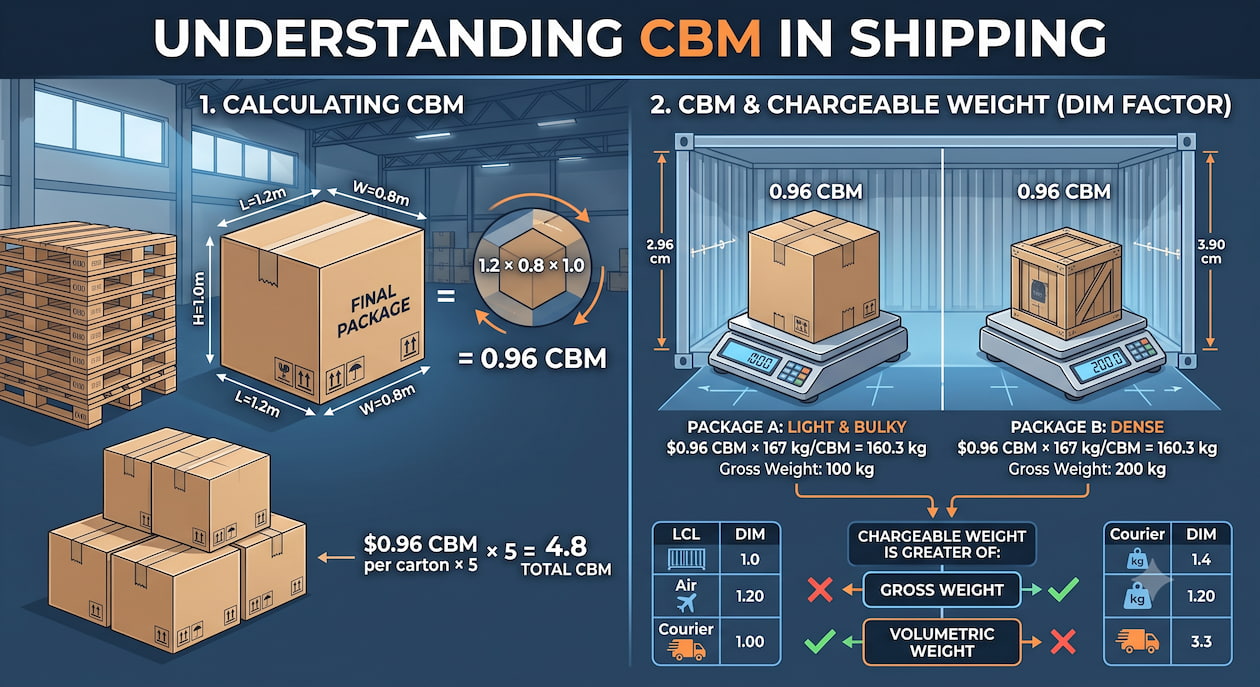
Calculating CBM sounds simple length × width × height but most calculation errors happen in the details: mixed units, forgotten quantities, or measuring the product instead of the packed carton.
This guide walks through the actual calculation process step by step, with worked examples in both metric and imperial units, so you can calculate CBM correctly the first time, every time.
If you're looking for the definition of CBM and why it matters, see our guide on what is cbm in shipping . This page focuses purely on the calculation itself.
CBM = Length × Width × Height × Quantity
All dimensions must be in **meters** before you multiply. If your measurements are in centimeters, inches, or millimeters, convert them first.
| Unit | Conversion to meters |
|---|---|
| Centimeters (cm) | divide by 100 |
| Millimeters (mm) | divide by 1,000 |
| Inches (in) | multiply by 0.0254 |
| Feet (ft) | multiply by 0.3048 |
Example : A carton measures 50 cm × 40 cm × 30 cm.
50 cm = 0.50 m, 40 cm = 0.40 m, 30 cm = 0.30 m
0.50 × 0.40 × 0.30 = 0.06 m³
This carton has a volume of 0.06 CBM
Most real shipments involve more than one carton. Multiply the single-carton CBM by the total quantity.
Example : Using the same carton above, you're shipping 120 identical cartons.
0.50 × 0.40 × 0.30 = 0.06 CBM
0.06 × 120 = 7.2 CBM
A 20-foot container holds roughly 28–33 CBM, so 7.2 CBM would use less than a quarter of the container — a strong candidate for an lcl vs fcl calculator rather than booking a full container.
Many US-based shippers receive carton dimensions in inches. Convert to meters before calculating don't multiply inches directly, or your result will be wrong by a large margin.
Example:A carton measures 24 in × 18 in × 12 in.
24 in × 0.0254 = 0.6096 m
18 in × 0.0254 = 0.4572 m
12 in × 0.0254 = 0.3048 m
0.6096 × 0.4572 × 0.3048 = 0.08498 m³
This carton is approximately 0.085 CBM. For 500 cartons: 0.085 × 500 = 42.5 CBM
If your shipment includes cartons of different sizes, calculate each carton type separately, then add the totals together. Don't average the dimensions averaging produces an inaccurate result.
Example: A shipment contains two carton types.
0.60 × 0.40 × 0.40 = 0.096 CBM per carton
0.096 × 200 = 19.2 CBM
0.45 × 0.35 × 0.25 = 0.0394 CBM per carton
0.0394 × 350 = 13.79 CBM
19.2 + 13.79 = 32.99 CBM
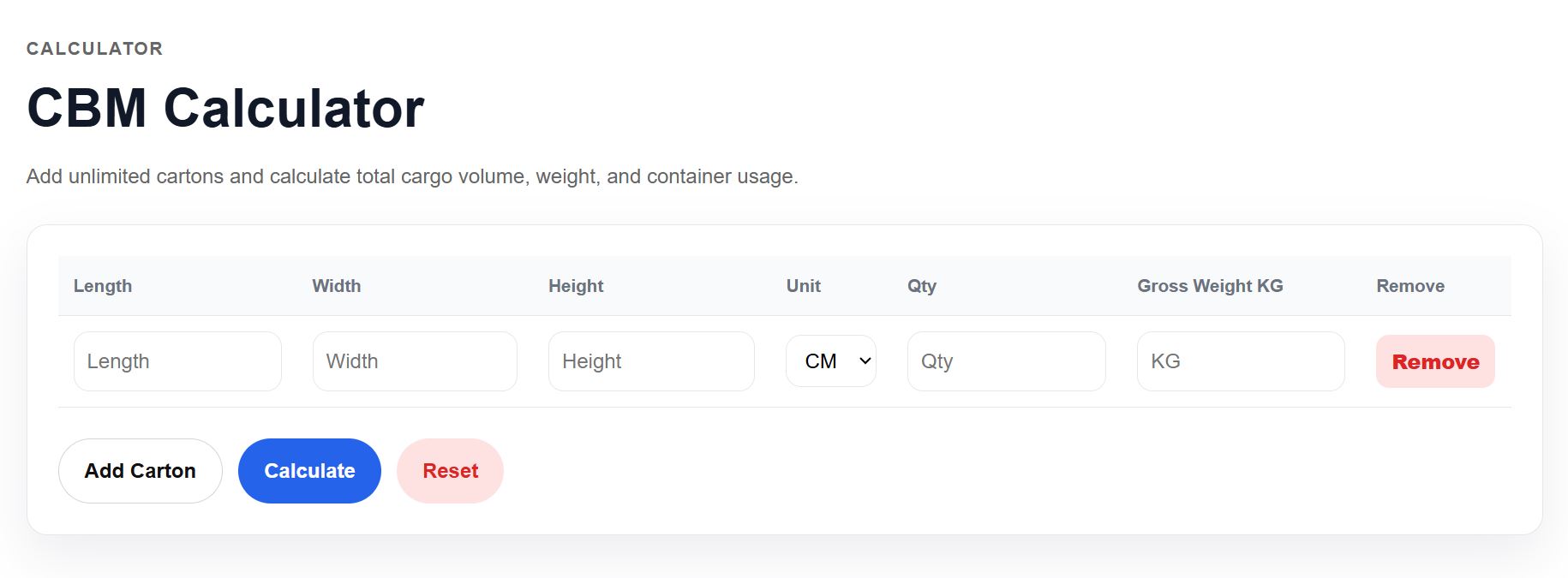
Manual calculation works fine for one or two carton types, but shipments with several sizes get error-prone fast. The cbm calculator lets you enter multiple carton types in one session and automatically totals the volume and weight for you.
Entering length in cm and height in inches without converting both to meters first is the single most common error. Always convert every dimension to meters before multiplying.
Calculating CBM for one carton and quoting that number as the total shipment volume understates the real figure sometimes by a factor of hundreds.
Freight forwarders need the outer, packed dimensions including padding, pallet base, and any protective packaging not the bare product dimensions.
Rounding each dimension before multiplying compounds the error across large quantities. Keep full decimal precision until the final total, then round.
As shown above, averaging dimensions across different carton types produces a wrong total. Calculate each size separately and sum the results.
| Carton Size (cm) | CBM per Carton | CBM for 100 Units |
|---|---|---|
| 30 × 30 × 30 | 0.027 | 2.7 |
| 40 × 30 × 30 | 0.036 | 3.6 |
| 50 × 40 × 30 | 0.06 | 6.0 |
| 60 × 40 × 40 | 0.096 | 9.6 |
| 80 × 60 × 60 | 0.288 | 28.8 |
Calculating CBM correctly comes down to three habits: convert every dimension to meters first, multiply by the correct quantity, and calculate mixed carton sizes separately before summing. Get those three right, and your freight quotes will be accurate from the first calculation.
For a faster and error free method especially with multiple carton types use the cbm calculator.
Yes. All dimensions must be in meters before multiplying, regardless of the unit they were originally measured in.
CBM measures physical volume in cubic meters. Volumetric Weight Caclulator converts that volume into a billable weight figure, mainly used in air freight pricing.
Yes, using the pallet's outer length, width, and stacked height. For palletized loads, pallet calculator our accounts for stacking limits as well.
Freight forwarders typically expect figures accurate to two decimal places. Small rounding differences are normal, but errors from unit mismatches or missed quantities can materially affect your quote.
Use the maximum length, width, and height at each dimension's widest point. This slightly overstates volume but avoids underquoting, which can lead to fees at origin or destination.
This article is provided for educational purposes only. Shipping costs, freight rates, container capacity, and operational requirements may vary by carrier, country, cargo type, and shipment conditions.