
Shipping Guide
Shipping Guide
I still remember one of my early export shipments from Karachi where the client confidently booked a “40ft container load” without checking the actual cargo dimensions. On paper, it looked perfect. In reality, the cargo was just slightly too tall for a standard 40ft unit, and we had to scramble last minute to switch to a 40ft high cube—adding both cost and delay.
That one mistake taught me something simple: container sizes and dimensions are not just numbers—they directly control your cost, space, and shipment success.
day-to-day operations.When we talk about container sizes, we are usually referring to standard ISO shipping containers used in sea freight. These containers are designed to fit globally standardized dimensions so they can move across ships, trucks, and rail networks without unloading cargo.
But here’s the practical reality:
So when a client says, “I need a full 40ft container,” what they actually mean is a 40-foot-long steel box with limited usable space inside that must match cargo dimensions carefully.
In theory, it sounds simple—just load cargo into a container. In practice, container dimensions affect:
Shipping lines charge based on container type (TEU/FEU), not just weight. Choosing wrong sizes increases cost immediately.
I’ve seen machinery stuck at loading yards because height clearance was ignored by just 2–3 cm.
Improper container selection leads to:
Incorrect declared container types can create mismatch issues in shipping documents and customs declarations.
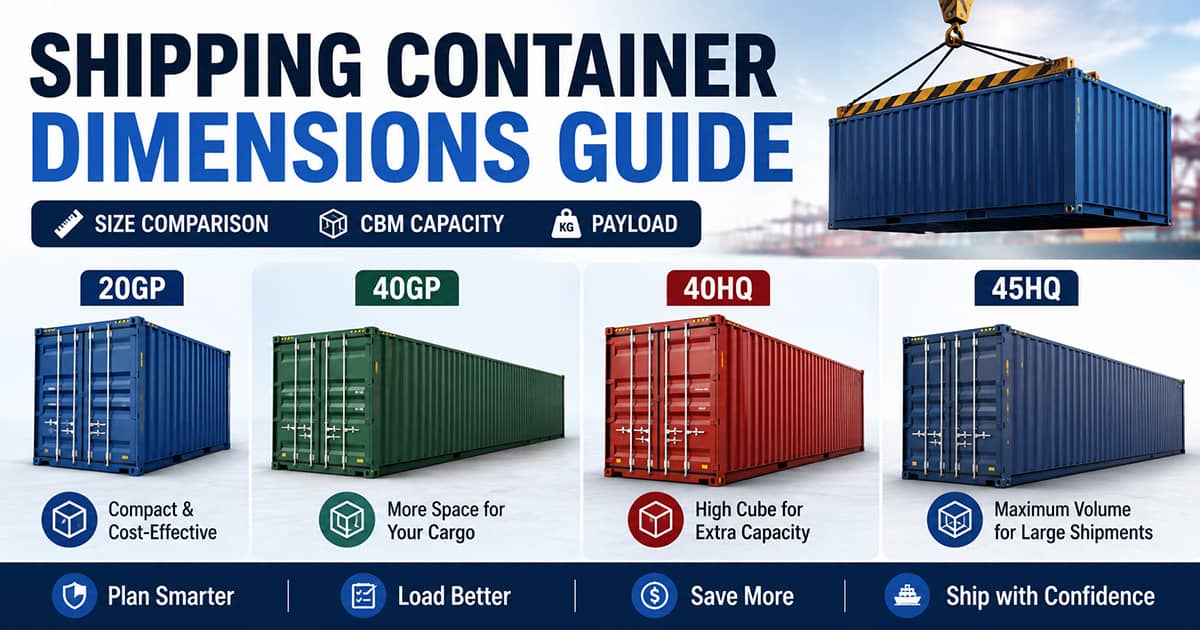
Let’s go through the most commonly used containers in global freight.
This is the most widely used container in shipping.
Internal Dimensions (Approx.):
Capacity:
Best for:
Real-world note:
I usually recommend 20ft containers for dense cargo. Many beginners wrongly choose 40ft thinking it’s always better. It’s not—especially for heavy goods.
The most commonly used container for general cargo.
Internal Dimensions (Approx.):
Capacity:
Best for:
Real-world note:
This is the “default” container in most exports. But I’ve seen companies waste space by not properly palletizing cargo inside.
This is where many shipments get saved.
Internal Dimensions (Approx.):
Capacity:
Best for:
Real-world note:
I once handled a shipment of oversized furniture where the standard 40ft failed by just a few centimeters. Switching to high cube solved everything—but increased freight cost by 12%. Still better than breaking cargo or reworking packing.
Here’s how experienced freight forwarders actually decide:
Step 1: Measure CBM (Volume)
Calculate:
Length × Width × Height (in meters)
Step 2: Check Weight Density
Step 3: Check Cargo Nature
Step 4: Confirm Port & Carrier Restrictions
Some shipping lines have strict weight caps.
Step 5: Optimize Loading Plan (Vanning Plan)
We always prepare a loading sketch before final booking.
After years in freight forwarding, these are the mistakes I see repeatedly:
❌ Ignoring Cargo Weight vs Volume
People choose containers based only on size, not density.
❌ Not Considering Packaging Material
Wooden pallets or crates can increase height unexpectedly.
❌ Overloading 20ft Containers
Carriers are strict—overweight containers are rejected or fined.
❌ Assuming All 40ft Containers Are Same
High cube vs standard makes a big difference.
❌ Last-Minute Container Change
This leads to:
Here are insights you only learn after dealing with real shipments:
✔ Always Ask for Actual Packed Dimensions
Not product dimensions—final packed size.
✔ Leave Buffer Space
Never plan container utilization at 100%. Always keep 5–10% space buffer.
✔ Use High Cube When in Doubt (But Calculate Cost)
Sometimes slightly higher freight is cheaper than repacking or splitting cargo.
✔ Double-Check With Carrier Rules
Each shipping line may differ slightly in payload limits.
✔ Pallet Efficiency Matters More Than You Think
Good pallet planning can save 10–15% container space.
TEU stands for Twenty-foot Equivalent Unit, and FEU stands for Forty-foot Equivalent Unit.
A 20ft container holds approximately 28–30 cubic meters.
It is used for bulky or lightweight cargo requiring extra vertical space.
Not always. Both have similar weight limits, but 40ft offers more volume.
You may need LCL shipping, container upgrade, or repacking.
Usually a 20ft container due to better weight distribution.
Yes, ISO standards keep dimensions mostly uniform globally.
This article is provided for educational purposes only. Shipping costs, freight rates, container capacity, and operational requirements may vary by carrier, country, cargo type, and shipment conditions.