
Shipping Guide
Shipping Guide
If you've ever arranged a shipment or searched for logistics services, you've probably come across the terms freight broker, freight forwarder, and 3PL provider. They often appear together, which makes it easy to assume they all do the same job.
They don't.
Each plays a different role in the supply chain, and choosing the wrong one can lead to unnecessary costs, delays, or services you don't actually need.
For example, a business importing products from China typically needs a freight forwarder to coordinate international shipping and customs documentation. On the other hand, a company shipping products between cities within the same country may only need a freight broker to find a reliable carrier. A growing e-commerce business, however, might benefit most from a 3PL provider that can store inventory, pack orders, and manage deliveries.
In this guide, we'll explain the difference between freight broker vs freight forwarder vs 3PL in simple terms, compare their responsibilities, and help you decide which service is the right fit for your business.
Quick Answer
If you're looking for a quick explanation, here's the difference:
| Service | Best For | Main Responsibility |
|---|---|---|
| Freight Broker | Domestic transportation | Connects shippers with carriers to move freight. |
| Freight Forwarder | International shipping | Organizes import and export shipments, documentation, and transportation. |
| 3PL (Third-Party Logistics) | End-to-end logistics | Manages warehousing, inventory, fulfillment, and transportation. |
Simply put:
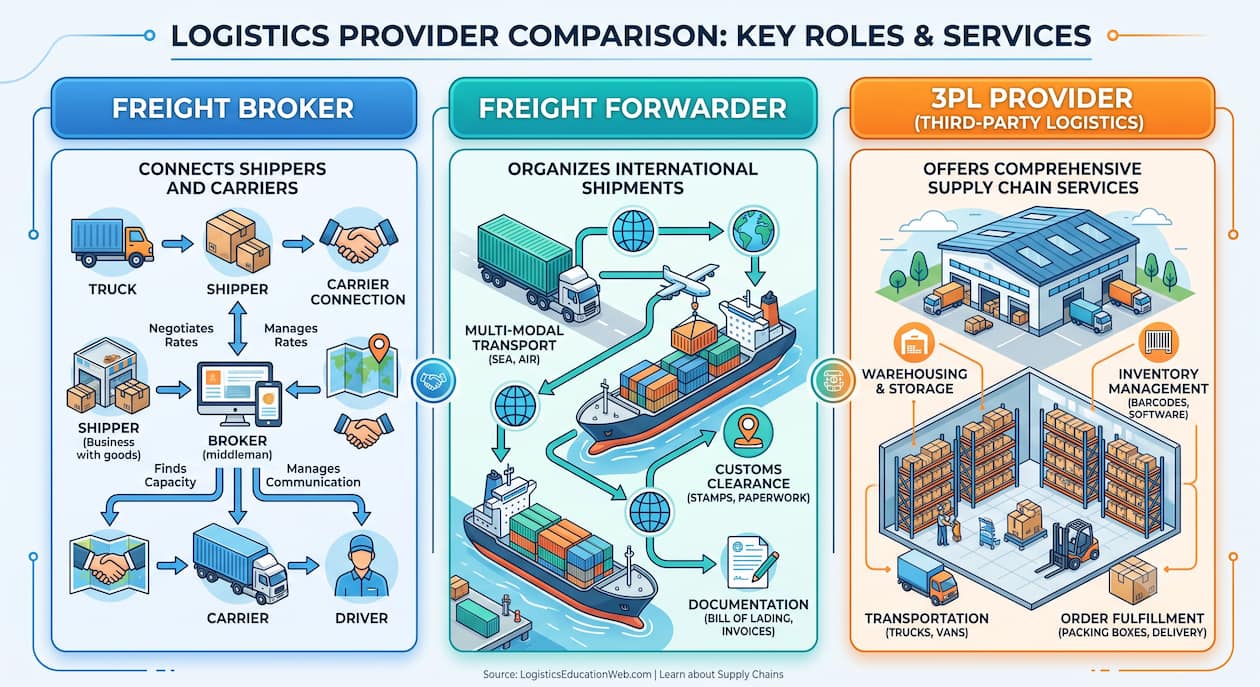
A freight broker is a licensed intermediary that connects businesses needing to ship goods with transportation companies that have available capacity.
Instead of owning trucks or moving freight themselves, brokers use their network of carriers to find the most suitable transportation option based on your shipment, timeline, and budget.
For example, imagine a furniture manufacturer in Texas needs to deliver products to retailers in Florida. Rather than contacting multiple trucking companies individually, the manufacturer can work with a freight broker who quickly finds an available carrier and negotiates a competitive rate.
A freight broker typically:
Freight brokers are commonly used for domestic road transportation, especially when businesses want flexibility without building direct relationships with multiple carriers.
A freight forwarder manages the transportation of goods, primarily for international imports and exports.
Unlike a freight broker, a freight forwarder coordinates multiple stages of the shipping process. They work with shipping lines, airlines, trucking companies, customs brokers, and port authorities to ensure cargo reaches its destination smoothly.
If you're importing products from China, Germany, or another country, a freight forwarder can organize the shipment from the supplier's warehouse all the way to your final delivery point.
Freight forwarders commonly arrange:
Rather than dealing with several service providers yourself, the freight forwarder acts as your central point of contact throughout the shipment.
A 3PL (Third-Party Logistics) provider offers a broader range of logistics services than either a freight broker or freight forwarder.
Instead of focusing only on transportation, a 3PL helps businesses manage day-to-day logistics operations. This often includes storing inventory, processing customer orders, packing products, arranging deliveries, and handling returns.
For growing businesses, outsourcing these activities to a 3PL can save time and reduce the need to operate their own warehouse.
A typical 3PL provider may offer:
For example, an online retailer selling across the country may store products in a 3PL warehouse. When a customer places an order, the 3PL picks the item, packs it, ships it, and updates the inventory automatically. This allows the retailer to focus on sales and customer growth instead of daily logistics.
Now that you know what each service does individually, let's compare them side by side.
The biggest difference is what they're responsible for.
A freight broker focuses on finding transportation. A freight forwarder manages international shipments, while a 3PL provider handles broader logistics operations, including warehousing and order fulfillment.
Freight Broker vs Freight Forwarder vs 3PL Comparison
| Feature | Freight Broker | Freight Forwarder | 3PL Provider |
|---|---|---|---|
| Primary Role | Connects shippers with carriers | Organizes international shipments | Manages logistics operations |
| Best For | Domestic freight | Imports and exports | End-to-end supply chain support |
| Transportation | ✔ | ✔ | ✔ |
| International Shipping | Limited | ✔ | ✔ (if offered) |
| Customs Support | Usually No | ✔ | Sometimes |
| Warehousing | No | Limited | ✔ |
| Inventory Management | No | No | ✔ |
| Order Fulfillment | No | No | ✔ |
| Typical Customers | Manufacturers, wholesalers | Importers, exporters | E-commerce, retailers, growing businesses |
A freight broker is the right choice when your main challenge is finding a reliable carrier to transport goods.
They are especially useful if you:
Example
A food manufacturer in Chicago needs to deliver products to supermarkets across different states every week.
Since the company already has its own warehouse and inventory team, it only needs transportation. A freight broker can quickly match each shipment with an available carrier without the manufacturer having to negotiate with dozens of trucking companies.
Choose a freight broker if transportation is your only requirement.
A freight forwarder is best suited for businesses involved in international trade.
freight forwarder is best suited for businesses involved in international trade. Importing or exporting goods involves much more than booking a container or cargo space. There are customs procedures, shipping documents, carrier bookings, and coordination between different countries.
A freight forwarder simplifies this process by managing these tasks on your behalf.
Example
A business in the United States imports furniture from Vietnam.
The freight forwarder can arrange:
Instead of dealing with multiple companies, the importer works with one logistics partner who coordinates the shipment from start to finish.
Choose a freight forwarder if you're shipping internationally.
A 3PL provider is the right option when transportation is only one part of your logistics needs.
Many growing businesses eventually reach a point where managing inventory, packing orders, and arranging deliveries becomes time-consuming. Rather than expanding their own warehouse operations, they outsource these activities to a 3PL.
Example
An online clothing store starts with a few daily orders but grows to hundreds of shipments every week.
Instead of renting a larger warehouse and hiring more staff, the business partners with a 3PL provider.
The 3PL receives inventory, stores it, processes customer orders, packs products, ships them, and even manages returns.
The retailer can then focus on marketing, customer service, and growing the business.
Choose a 3PL if you want to outsource part or all of your logistics operations.
The answer depends on your shipping requirements rather than the size of your business.
Use this quick guide:
| Your Requirement | Recommended Service |
|---|---|
| Find a truck for domestic freight | Freight Broker |
| Import or export goods internationally | Freight Forwarder |
| Store inventory and fulfill customer orders | 3PL Provider |
| Need customs documentation | Freight Forwarder |
| Need warehouse and distribution services | 3PL Provider |
| Only need transportation | Freight Broker |
Absolutely.
Many businesses work with multiple logistics providers because each one specializes in a different area.
For example:
This combination allows businesses to benefit from specialized expertise at each stage of the supply chain.
If you're still unsure, think of it this way:
While their services may overlap in some situations, their primary responsibilities are different. Understanding these differences helps you choose the right logistics partner, avoid paying for services you don't need, and build a more efficient supply chain.
Choosing the wrong logistics service can lead to higher costs, shipping delays, and unnecessary frustration. Here are a few common mistakes businesses make—and how to avoid them.
This is one of the biggest misconceptions.
A freight broker may help you find a carrier but won't typically handle customs clearance. A freight forwarder can arrange international shipping but may not offer warehousing or order fulfillment. A 3PL can manage inventory and distribution but isn't always the best choice if you only need transportation.
Before signing an agreement, confirm exactly what services are included.
The lowest quote isn't always the best value.
Ask what's included in the price and whether there are additional charges for storage, documentation, customs, or special handling. Comparing total service value is more useful than comparing rates alone.
A logistics solution that works today may not meet your needs a year from now.
If your shipment volume is growing, consider whether your logistics partner can scale with your business. Switching providers frequently can disrupt operations and increase costs.
Understanding the difference between a freight broker, freight forwarder, and 3PL makes it much easier to choose the right logistics partner.
If you simply need someone to arrange transportation, a freight broker is usually the right fit. If you're importing or exporting goods, a freight forwarder can manage the complexities of international shipping. If you're looking to outsource warehousing, inventory, and order fulfillment, a 3PL provider offers a more complete logistics solution.
The best choice depends on your business model, shipping requirements, and long-term goals. Taking a few minutes to understand these differences can save time, reduce costs, and help build a more efficient supply chain.
A freight broker connects shippers with carriers, mainly for domestic transportation. A freight forwarder manages international shipments, including transportation, documentation, and customs coordination.
No. A freight forwarder specializes in moving goods, particularly across international borders. A 3PL manages broader logistics functions such as warehousing, inventory management, order fulfillment, and distribution.
Yes. Many logistics companies offer multiple services under one roof. They may provide freight forwarding for international shipments while also operating warehouses and fulfillment centers as a 3PL. Always review the specific services they provide rather than relying on the company title.
Not always. If you're managing a small number of orders, handling logistics in-house may be more cost-effective. As order volume increases, a 3PL can help improve efficiency and free up time to focus on growing the business
In most cases, a freight forwarder is the best choice because they can coordinate international transportation, shipping documentation, and customs processes.
Yes. This is a common setup. For example, a freight forwarder can import your products from overseas, while a 3PL stores the inventory and fulfills customer orders after the goods arrive.
This article is provided for educational purposes only. Shipping costs, freight rates, container capacity, and operational requirements may vary by carrier, country, cargo type, and shipment conditions.