
Shipping Guide
Shipping Guide
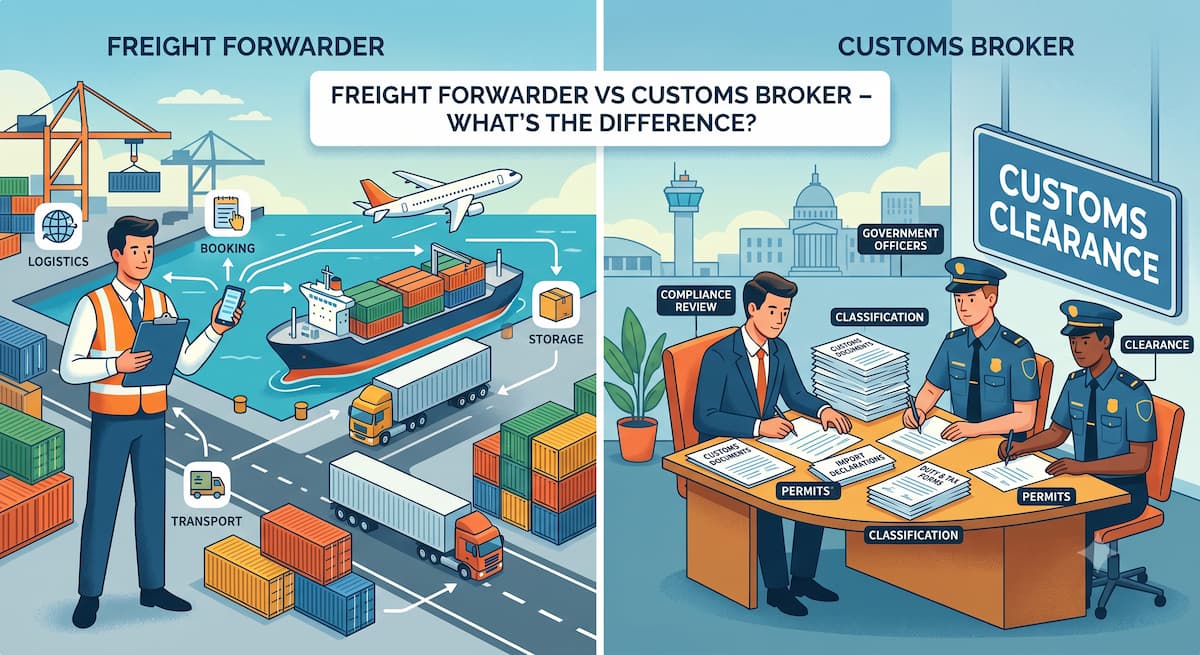
If you're importing or exporting goods, you may wonder whether you need a freight forwarder, a customs broker, or both. The short answer is this:
A freight forwarder manages the transportation of your cargo from one country to another.
A freight forwarder manages the transportation of your cargo from one country to another.
Many businesses use both because they perform different jobs. A freight forwarder gets your goods to the destination, while a customs broker helps those goods legally enter the country. Some companies offer both services under one roof, but they remain separate functions with different responsibilities and, in many countries, different licensing requirements.
Choosing the wrong service can lead to customs delays, unexpected charges, missed delivery deadlines, or even penalties. Understanding the difference helps you avoid unnecessary costs and choose the right support for your shipment.
| If you need to... | You need... |
|---|---|
| Arrange international transportation | Freight Forwarder |
| Clear goods through customs | Customs Broker |
| Book ocean or air freight | Freight Forwarder |
| Calculate import duties and taxes | Customs Broker |
| Prepare customs declarations | Customs Broker |
| Coordinate pickup, warehousing and delivery | Freight Forwarder |
Import goods internationally with minimal hassle Often both
A freight forwarder is a logistics specialist who organizes the movement of cargo between countries.
Although they usually do not own ships, aircraft, or trucks, they coordinate transportation using a network of carriers and logistics providers.
Their primary objective is to move your shipment efficiently, safely, and cost-effectively.
Typical freight forwarding services include:
Think of a freight forwarder as the project manager of your international shipment.
A customs broker specializes in clearing imported or exported goods through customs authorities.
Their role focuses on compliance rather than transportation.
A customs broker ensures that shipments meet all legal import or export requirements before customs releases the cargo.
Common customs broker responsibilities include:
In many countries, customs brokers must hold government-issued licenses or certifications.
| Feature | Freight Forwarder | Customs Broker |
|---|---|---|
| Primary role | Transport management | Customs clearance |
| Focus | Moving cargo | Regulatory compliance |
| Books freight | Yes | Usually No |
| Arranges shipping routes | Yes | No |
| Customs declarations | Sometimes (where permitted) | Yes |
| Calculates duties | Limited | Yes |
| Handles customs inspections | Assists | Primary responsibility |
| Inland transportation | Yes | Rarely |
| Warehousing | Often | Rarely |
| Licensed by customs authority | Depends on country | Usually Yes |
| Best for | International shipping | Import compliance |
The answer depends on your shipment and experience.
The answer depends on your shipment and experience.
Example
A furniture manufacturer in Vietnam exports products to a retailer in the UK.
The retailer hires a freight forwarder to:
Choose a Customs Broker if:
Example
An importer purchases machinery directly from a supplier who arranged transportation.
Only customs clearance remains.
Hiring a customs broker is sufficient.
You Need Both When:
Most international shipments benefit from both services.
Example:
Example:
The freight forwarder:
The customs broker:
Each professional focuses on different parts of the supply chain.
Can One Company Be Both?
Yes.
Many logistics companies provide both freight forwarding and customs brokerage services.
However, these remain separate functions.
Some companies employ licensed customs brokers while also operating as freight forwarders.
Some companies employ licensed customs brokers while also operating as freight forwarders.
Always ask:
Knowing who handles each stage avoids confusion later.
Responsibility depends on the issue.
| Problem | Usually Responsible |
|---|---|
| Flight cancellation | Carrier |
| Vessel delay | Shipping line |
| Poor route planning | Freight Forwarder |
| Incorrect customs declaration | Customs Broker |
| Wrong HS Code | Customs Broker or Importer |
| Missing commercial invoice | Exporter |
| Incorrect shipment information | Shipper |
| Customs inspection | Customs authority |
Importers remain legally responsible for the accuracy of information submitted to customs, even if a broker prepares the paperwork.
Cost Differences
Freight forwarding and customs brokerage are charged differently because they provide different services.
Freight Forwarder Costs Depend On
Customs Broker Costs Depend On
Avoid comparing these costs directly because they cover different parts of the shipping process.
Freight Forwarder
Advantages
Disadvantages
Customs Broker
Advantages
Disadvantages
Assuming They're the Same Service
Transportation and customs compliance are different specializations.
Choosing Based Only on Price
The cheapest freight rate may result in higher destination charges or poor service.
Ignoring Customs Documentation
Missing invoices, incorrect HS Codes, or incomplete certificates often cause avoidable delays.
Hiring a Freight Forwarder That Doesn't Handle Customs
Many first-time importers assume customs clearance is included automatically. Always confirm what services are covered.
Incorrect Product Classification
Using the wrong HS Code may result in:
Waiting Until Cargo Arrives
Preparing customs documents after arrival increases storage charges and demurrage risks.
After years in international logistics, one pattern appears repeatedly: businesses often focus on getting the lowest freight rate while overlooking customs preparation.
In reality, many costly delays happen because of incomplete paperwork, incorrect product classifications, or missing permits—not because of transportation issues.
A few practical recommendations:
Good planning before the shipment leaves is usually far less expensive than solving problems after it arrives.
When comparing a freight forwarder vs customs broker, remember that you're not choosing between two competing services you are choosing between two different areas of expertise.
A freight forwarder is responsible for planning and coordinating the movement of your cargo across borders. A customs broker focuses on ensuring your shipment complies with customs laws and can be legally released into the destination country.
For many international shipments, especially commercial imports and exports, using both services provides the most efficient and reliable solution. Before booking your shipment, clarify who will handle transportation, who will manage customs clearance, and what services are included. That simple conversation can prevent delays, unexpected costs, and compliance issues later.
No. A freight forwarder manages transportation, while a customs broker handles customs clearance and regulatory compliance.
In some countries, yes. However, customs procedures can be complex, and many importers hire a broker to reduce the risk of delays or compliance errors.
Sometimes. Some freight forwarders employ licensed customs brokers or have customs brokerage divisions. Others work with third-party brokers.
The importer is generally responsible for paying applicable customs duties, taxes, and government fees unless another arrangement is agreed under the sales contract or Incoterms.
Not always. If transportation is already arranged, you may only need customs brokerage. If you're managing customs yourself, you may only need freight forwarding. Many businesses, especially those new to international trade, use both.
Using both a freight forwarder and a customs broker often provides the smoothest experience, particularly for international shipments involving multiple transport modes or complex customs requirements.
No. A customs broker cannot legally reduce duties but can help ensure goods are classified correctly so you pay the amount required under customs regulations.
The customs broker typically communicates with customs officials, submits declarations, responds to queries, and coordinates inspections when necessary.
This article is provided for educational purposes only. Shipping costs, freight rates, container capacity, and operational requirements may vary by carrier, country, cargo type, and shipment conditions.