
Shipping Guide
Shipping Guide
If you're importing goods into the UK, one of the first shipping decisions you'll face is whether to choose Groupage (Less than Container Load or LCL) or Full Container Load (FCL).
The right choice can save thousands of pounds in freight costs, reduce delays, and help protect your cargo during transit. The wrong one can increase handling charges, extend delivery times, or leave you paying for space you don't actually need.
There's no universal winner. The better option depends on how much you're shipping, how quickly you need it, and your overall shipping strategy.
This guide explains the differences in simple terms so you can choose the most suitable option for your business.
| Feature | Groupage (LCL) | FCL |
|---|---|---|
| Container Usage | Shared with other importers | Exclusive use of one container |
| Best For | Small shipments | Large shipments |
| Shipping Cost | Pay only for space used | Pay for the entire container |
| Transit Time | Usually longer | Usually faster |
| Cargo Handling | Multiple handling points | Minimal handling |
| Risk of Damage | Slightly higher | Lower |
| Flexibility | High | Lower for small shipments |
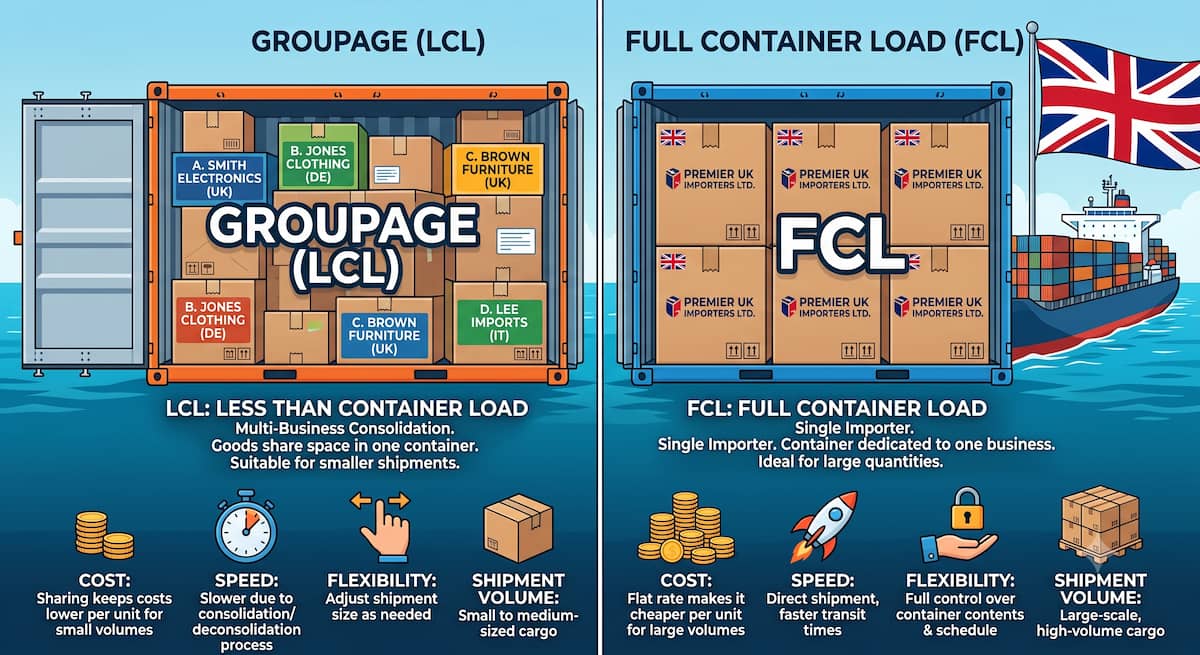
Groupage, commonly called LCL (Less than Container Load), is a shipping method where multiple businesses share space inside one shipping container.
Instead of paying for an entire container, you only pay for the volume or weight your cargo occupies.
For example, if your shipment fills only 5 cubic metres (CBM), there's little financial sense in booking a full 40-foot container. Your freight forwarder combines your cargo with shipments from other importers heading to the same destination.
Once the container reaches the UK, it is unpacked at a consolidation warehouse, and each shipment is delivered separately.
This is one of the most popular options for small and medium-sized businesses importing from countries such as China, India, Turkey, or Vietnam.
FCL stands forFull Container Load.
Although the name suggests the container must be completely full, that's not actually the case.
FCL simply means one importer books the entire container, regardless of whether it's filled to 100% capacity.
Your cargo is loaded once at origin, sealed inside the container, and normally remains untouched until it reaches the destination.
Because there is less handling throughout the journey, FCL generally offers faster transit times and a lower risk of cargo damage.
This is usually the deciding factor.
You only pay for the space your cargo occupies.
This makes Groupage much more economical for smaller shipments.
However, many first-time importers only compare the ocean freight rate and overlook additional charges such as:
These fixed charges can make very small shipments more expensive than expected.
With FCL, you're paying for the entire container.
Even if it's only 60% full, the container cost remains the same.
As shipment volume increases, the cost per unit usually becomes much lower than Groupage.
FCL is generally faster.
A full container moves directly through the shipping process without waiting for other cargo to be consolidated.
Groupage shipments involve additional stages:
Each step adds time.
If your products are needed urgently, FCL often provides a more predictable schedule.
A simple guideline many freight forwarders use is:
This isn't a fixed rule. Freight rates change throughout the year, so it's always worth requesting quotes for both options.
Every time cargo is loaded or unloaded, there's a small risk of damage.
With Groupage:
With FCL:
Businesses importing fragile products, electronics, or premium goods often prefer FCL for this reason.
Groupage is much more flexible.
You don't need to wait until you've accumulated enough inventory to fill a container.
This can help businesses:
FCL works best when you consistently import larger volumes.
Groupage is usually the better option if you:
Many UK ecommerce businesses start with Groupage before moving to FCL as sales increase.
FCL is often the better choice if you:
Many furniture, construction materials, and wholesale importers regularly use FCL because it provides better long-term shipping economics.
Imagine two UK businesses importing products from Shenzhen, China.
Business A
Imports:
• 4 CBM of home décor products every month.
Booking a full 40-foot container would mean paying for a large amount of unused space. Groupage is the obvious choice because the business only pays for the cargo it actually ships.
Business B
Imports:
• 24 CBM of furniture every month.
Although Groupage is possible, the combined LCL charges could approach the cost of a full container.
In this case, FCL is likely to offer:
Many people assume shipping costs depend only on container size, but several factors influence freight rates.
These include:
This is why experienced freight forwarders often recommend requesting both an LCL and an FCL quotation before making a decision.
Sometimes the difference is surprisingly small.
Always compare the total landed cost, not just the shipping rate.
Groupage shipments often include additional handling costs after arrival.
A half-empty container isn't automatically cheaper. Calculate the full cost before booking.
Groupage cargo shares container space with other shipments. Strong export packaging helps reduce the risk of damage.
Freight prices change regularly. Getting quotations early gives you more flexibility.
For most UK importers, the decision between Groupage and FCL comes down to balancing shipment size, cost, speed, and risk.
If you're importing smaller volumes, Groupage is usually the most practical and cost-effective solution. As your order quantities grow, it's worth comparing FCL rates, as a full container can become more economical while also offering faster transit and better cargo protection.
Rather than relying on a general rule, request quotes for both options whenever your shipment starts approaching the point where either method could make financial sense. Looking at the complete landed cost not just the freight rate will help you make a better long-term decision for your business.
Yes. Groupage is another term for Less than Container Load (LCL), where multiple importers share one shipping container.
No. FCL is usually more economical only when your shipment volume is large enough to justify booking an entire container.
Yes. Many logistics companies offer multiple services under one roof. They may provide freight forwarding for international shipments while also operating warehouses and fulfillment centers as a 3PL. Always review the specific services they provide rather than relying on the company title.
Generally, yes. Because Groupage shipments must be consolidated and later separated, transit times are often slightly longer.
Many freight forwarders recommend comparing FCL pricing once your shipment reaches around 15–20 CBM, although the exact break-even point depends on current freight rates.
FCL is generally safer because the cargo is loaded once, sealed, and handled less frequently during transit.
Yes. Some businesses choose FCL even with partially filled containers if they need faster delivery, improved cargo protection, or greater control over their shipments.
This article is provided for educational purposes only. Shipping costs, freight rates, container capacity, and operational requirements may vary by carrier, country, cargo type, and shipment conditions.