
Shipping Guide
Shipping Guide
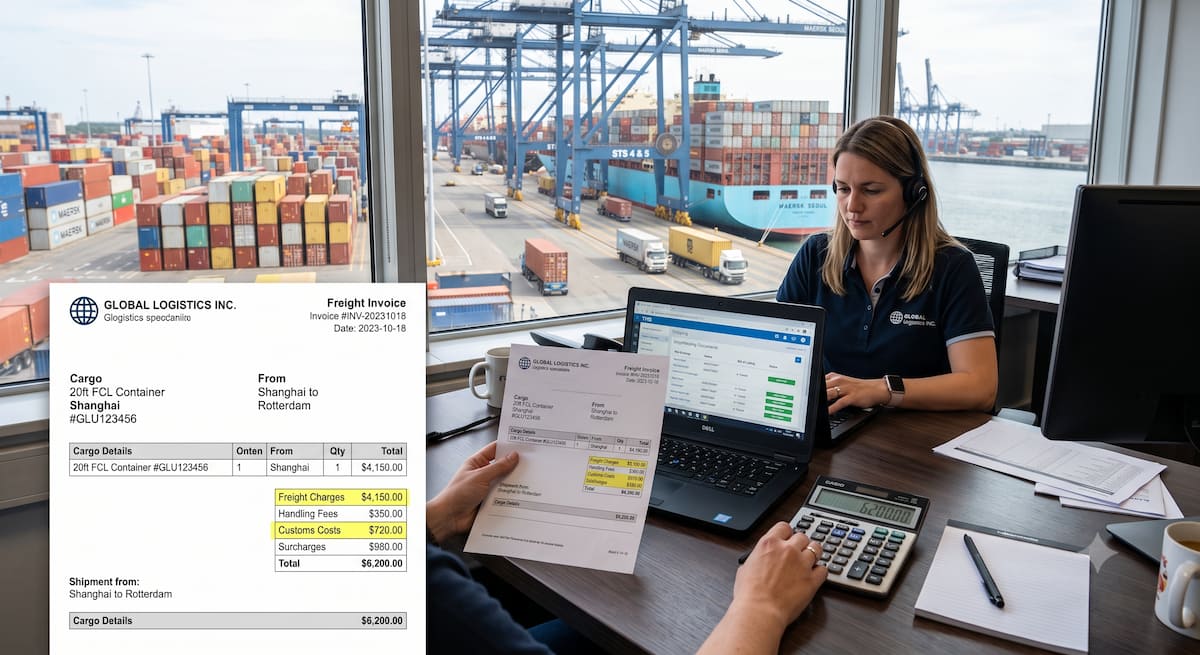
A freight invoice is not just a bill showing the total amount you need to pay. It is a detailed breakdown of transportation costs, handling fees, surcharges, and additional services involved in moving your shipment.
To read a freight invoice correctly, you need to understand which charges are expected, which depend on the shipment, and which may indicate errors or unnecessary costs.
Many importers focus only on the freight rate quoted by the forwarder but are surprised when the final invoice includes charges such as destination handling, documentation fees, customs-related costs, storage, or equipment fees.
A proper freight invoice review helps you:
The key is not only looking at the final amount. You need to understand what each charge represents and why it applies.
| If you want to check... | Review this section |
|---|---|
| Main transportation cost | Freight charge |
| Extra fees added by carriers | Surcharges |
| Port-related costs | Origin and destination charges |
| Customs-related expenses | Duties, taxes, clearance fees |
| Unexpected charges | Storage, demurrage, detention |
| Incorrect billing | Shipment details and agreed quotation |
Before paying, always compare the invoice against the original freight quotation, shipment terms (Incoterms), and agreed charges.
A freight invoice is a document issued by a freight forwarder, shipping line, airline, or logistics provider requesting payment for transportation and related services.
Unlike a simple product invoice, a freight invoice covers the movement of goods.
It may include:
The final amount depends on several factors:
A freight invoice normally contains several sections.
Understanding each section helps you identify mistakes.
Before checking charges, confirm the shipment details.
Look for:
A freight company may handle hundreds of shipments. Administrative mistakes can happen.
Common errors include:
Always verify the invoice belongs to your shipment.
The freight charge is the basic transportation cost.
Examples:
Ocean Freight
Usually charged as:
Examples:
Air Freight
Usually calculated based on:
A shipment weighing 100 kg may be charged as 150 kg if the volume creates higher chargeable weight.
Origin charges are costs incurred before the shipment leaves the exporting country.
Common examples:
| Charge | Explanation |
|---|---|
| Export documentation | Preparation of shipping documents |
| Origin handling | Handling at warehouse or port |
| Trucking | Transport from supplier to port |
| Export customs clearance | Export declaration processing |
| Terminal handling charges | Port handling before loading |
These charges vary significantly by country and port.
Many importers are surprised by destination charges because they focus only on the freight rate.
Destination charges may include:
| Charge | Explanation |
|---|---|
| Destination handling | Handling after arrival |
| Delivery order fee | Release documentation |
| Terminal charges | Port-related handling |
| Customs clearance | Import declaration processing |
| Local transportation | Delivery to final location |
A low ocean freight rate does not always mean a cheaper shipment.
For example:
A forwarder may offer a very competitive ocean freight rate but have higher destination fees.
Always compare the total landed logistics cost, not only the freight rate.
Shipping rates often include additional carrier surcharges.
Common examples:
Fuel Surcharge
Applied because fuel prices affect transportation costs.
Examples:
Peak Season Surcharge (PSS)
Applied during periods of high shipping demand.
Common periods:
Currency Adjustment Factor (CAF)
Applied when currency fluctuations affect carrier costs.
Congestion Surcharge
May apply when ports experience delays or heavy traffic.
| Charge | Usually Applies To | Reason |
|---|---|---|
| Ocean freight | Sea shipments | Main transportation |
| Air freight | Air shipments | Main transportation |
| THC | Sea freight | Terminal handling |
| Documentation fee | Most shipments | Shipping paperwork |
| Customs clearance | Imports | Customs processing |
| Delivery fee | Door delivery | Local transport |
| Storage | Delayed clearance | Warehouse/terminal usage |
| Demurrage | Containers held too long | Beyond free time |
| Detention | Container equipment delay | Late container return |
The word “hidden” does not always mean the freight company is intentionally hiding costs.
Many charges are missed because they depend on circumstances.
Common examples:
Demurrage occurs when an import container stays inside the port beyond the free storage period.
Example:
A container arrives on Monday.
The shipping line allows 5 free days.
The importer clears cargo on day 8.
The extra days may create demurrage costs.
How to avoid:
Detention happens when the container is removed from the port but not returned within the allowed period.
Example:
You pick up a container but return the empty container late.
The shipping line charges detention.
If cargo remains at a warehouse, terminal, or airport beyond free time, storage charges may apply.
Some shipments are selected for inspection.
Possible costs:
These are usually outside the freight forwarder's control.
Many disputes happen because customers compare the invoice with the original quotation.
A freight quote usually includes estimated costs based on available information.
The final invoice may change because:
Example:
A supplier initially provides:
After packing:
The freight cost will naturally increase.
Use this checklist:
check
Confirm
Incoterms determine who pays which costs.
Examples:
EXW
Buyer usually pays almost all transportation costs.
FOB
Seller handles export side. Buyer handles ocean freight and import costs.
CIF
Seller pays freight and insurance up to destination port.
Ask:
A cheaper freight rate may come with higher local charges. Always compare:
Total Cost = Freight + Origin Charges + Destination Charges + Possible Additional Fees
Many importers misunderstand who is responsible for specific charges.
A wrong assumption can create thousands in unexpected costs.
Containers, warehouses, and terminals have free time limits. Ignoring these dates creates avoidable charges.
Not Reviewing Previous Invoices
A freight invoice should always be reviewed before payment, especially for international shipments.
A good process is:
For regular importers, creating a shipment cost spreadsheet is highly valuable.
Track:
Over time, this helps identify the real cost of importing products.
Learning how to read a freight invoice helps importers control costs and avoid unpleasant surprises.
The biggest mistake is focusing only on the freight rate. A shipment's true cost includes transportation, handling, customs, port charges, and possible delays.
Before approving payment, compare the invoice with your quotation, shipment terms, and actual shipment details.
A well-reviewed freight invoice is not just about saving money it helps you build a more predictable and efficient supply chain.
A freight invoice can be issued by a freight forwarder, shipping line, airline, trucking company, or logistics provider depending on who provided the service.
No. A commercial invoice shows the value of goods being sold. A freight invoice shows transportation and logistics charges.
Common reasons include:
For imports, destination charges, customs-related fees, demurrage, and detention are among the most commonly unexpected costs.
Before shipping:
THC means Terminal Handling Charge. It covers handling activities at the port or terminal, such as moving containers and loading/unloading operations.
Yes. If a charge is unclear or inconsistent with the agreed quotation, ask your freight provider for clarification or supporting documents.
This article is provided for educational purposes only. Shipping costs, freight rates, container capacity, and operational requirements may vary by carrier, country, cargo type, and shipment conditions.