
Shipping Guide
Shipping Guide
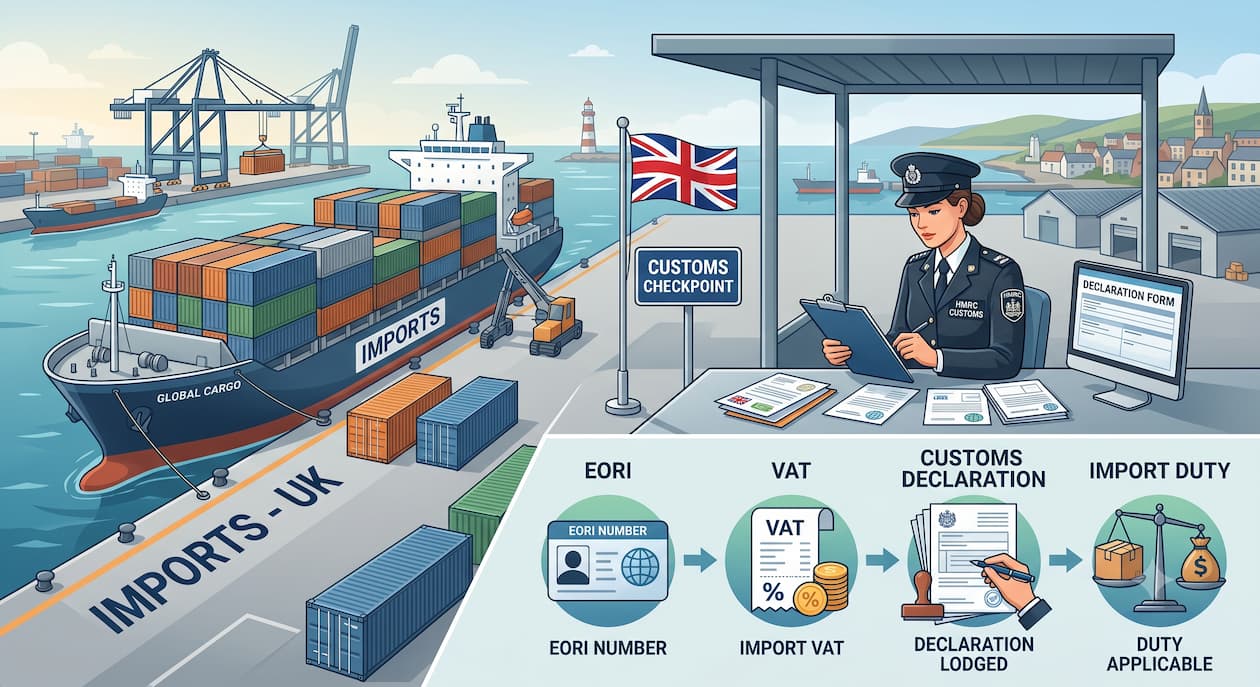
If you're importing goods into the UK after Brexit, the biggest change is that imports from the European Union are now treated much like imports from most other countries. This means many shipments require customs declarations, import VAT, and, depending on the goods and their origin, customs duty. You'll also need the correct documentation, an EORI number, and a clear understanding of who is responsible for customs clearance under your agreed Incoterms.
For businesses, importing into the UK is no longer just about arranging transport. Customs compliance has become just as important as freight planning. Missing documents, incorrect commodity codes, or misunderstanding VAT responsibilities can lead to delays, unexpected costs, or customs penalties.
This guide explains the entire UK import process after Brexit, what documents you need, how duties and VAT work, and the practical steps businesses should follow to import goods smoothly.
| If you need to... | What you should do |
|---|---|
| Import goods into the UK | Submit customs declarations (or appoint a customs broker) |
| Pay import taxes | Be prepared for import VAT and possibly customs duty |
| Import commercially | Obtain a UK EORI number |
| Reduce customs duty | Check if your goods qualify under a Free Trade Agreement (FTA) |
| Avoid customs delays | Use accurate HS codes, commercial invoices, and shipping documents |
| Simplify the process | Work with an experienced freight forwarder or customs broker |
Before Brexit, goods generally moved freely between the UK and EU without customs formalities.
Since the UK left the EU Single Market and Customs Union, imports from EU countries now follow customs procedures similar to shipments arriving from Asia, North America, or other international markets.
Today, UK importers may need to:
The exact requirements depend on.
A typical import shipment follows these steps:
Although this process sounds straightforward, errors at any stage can delay delivery and increase costs.
Most commercial imports require several documents.
| Document | Purpose |
|---|---|
| Commercial Invoice | Shows buyer, seller, goods, value, and terms |
| Packing List | Details package contents and dimensions |
| Bill of Lading (Sea) | Transport contract and cargo receipt |
| Air Waybill (Air Freight) | Air transport document |
| Customs Declaration | Required for customs clearance |
| Import Licence (where applicable) | Needed for regulated goods |
| Certificate of Origin | May allow reduced customs duty under trade agreements |
| Insurance Certificate | Required if cargo is insured |
Certain products, including food, chemicals, medical devices, plants, and animal products, may require additional certificates.
Yes.
A UK business importing commercial goods generally needs a UK EORI (Economic Operators Registration and Identification) number beginning with GB.
Without an EORI number:
Businesses trading with Northern Ireland may also require an XI EORI depending on the transaction.
A customs declaration tells HM Revenue & Customs (HMRC):
Most importers appoint:
to submit declarations electronically on their behalf.
Import VAT works differently from customs duty.
Import VAT is generally charged on:
Many VAT-registered UK businesses use Postponed VAT Accounting (PVA), allowing import VAT to be accounted for on the VAT return instead of paying it immediately at the border, improving cash flow.
Not every shipment attracts customs duty.
Duty depends on:
For example:
This is why determining the origin of goods is different from knowing where they were shipped from.
Many importers confuse these two concepts.
| Country of Export | Country of Origin |
|---|---|
| Where goods were shipped from | Where goods were manufactured or substantially transformed |
Example:
A machine manufactured in Germany but shipped from the Netherlands has:
Duty is often determined by origin, not export location.
Every imported product must be classified using a Harmonized System (HS) code.
The HS code determines:
Using the wrong commodity code may result in:
Incoterms define who is responsible for transport costs, insurance, customs formalities, and risk.
| Incoterm | Buyer Responsibility |
|---|---|
| EXW | Highest responsibility |
| FCA | Buyer arranges main transport |
| FOB | Buyer arranges ocean freight |
| CIF | Seller pays freight and insurance, buyer clears imports |
| DAP | Buyer pays import charges |
| DDP | Seller pays import duties and VAT (subject to agreement) |
Many UK businesses misunderstand DDP. Even when suppliers offer Delivered Duty Paid, both parties should clearly understand who is acting as importer of record and how VAT obligations are managed.
Import costs extend beyond freight rates.
Typical charges include:
Final costs depend on:
| Sea Freight | Air Freight |
|---|---|
| Lower shipping cost | Higher shipping cost |
| Longer transit | Faster delivery |
| Suitable for bulk cargo | Suitable for urgent shipments |
| Better for heavy goods | Better for lightweight, high-value goods |
The right option depends on cost, urgency, and cargo type.
Many customs delays result from avoidable errors.
Common mistakes include:
A UK retailer imports furniture from Italy.
The supplier ships under FOB Genoa.
The UK importer:
Although Italy is an EU country, the shipment still goes through customs because of Brexit.
Challenges
Businesses often focus on finding the lowest freight quote, but customs compliance usually has a greater impact on total landed cost. A shipment delayed because of an incorrect HS code, missing origin evidence, or inaccurate customs value can generate storage charges, demurrage, and delivery delays that far exceed any savings made on transport.
Before every shipment:
A small investment in preparation often prevents costly problems after the goods arrive.
Importing goods into the UK after Brexit involves more customs formalities than before, but the process is manageable when you understand the requirements. Success depends on accurate documentation, the correct HS commodity code, a valid UK EORI number, and a clear understanding of VAT, customs duty, and Incoterms.
Rather than focusing only on shipping costs, consider the full landed cost of your goods, including taxes, clearance fees, and potential delays. Careful planning and strong customs compliance will help your shipments move efficiently while reducing unexpected expenses.
No. Customs duty depends on the commodity code, the origin of the goods, and whether a preferential trade agreement applies.
No. Import VAT is a tax on imported goods, while customs duty is a tariff that may apply based on the product's classification and origin.
Generally, no. Since Brexit, most commercial imports from the EU require customs declarations.
You may be able to reduce or eliminate duty by using a qualifying Free Trade Agreement, provided your goods meet the applicable rules of origin and you have the necessary evidence.
An incorrect HS code can result in the wrong duty being paid, customs delays, additional assessments, penalties, or audits by HMRC.
Using both a freight forwarder and a customs broker often provides the smoothest experience, particularly for international shipments involving multiple transport modes or complex customs requirements.
Under DAP (Delivered at Place), the buyer is generally responsible for import clearance and import charges. Under DDP (Delivered Duty Paid), the seller agrees to deliver the goods with import duties and taxes paid, subject to the agreed contractual responsibilities.
This article is provided for educational purposes only. Shipping costs, freight rates, container capacity, and operational requirements may vary by carrier, country, cargo type, and shipment conditions.